
The throttle position sensor (TPS) monitors throttle plate movement and sends this data to the engine control unit (ECU), which adjusts fuel and ignition for smooth performance. If the TPS is miscalibrated, the engine may struggle with the air-fuel mixture, leading to rough idling, poor acceleration, hesitation, or even stalling. Proper calibration is key to good throttle response and fuel efficiency.
A TPS problem does not always mean sensor damage. Often, the sensor just needs a reset for the ECU to relearn settings. This can happen after you disconnect the battery or perform maintenance. Many cars allow a manual reset without a scanner by using simple methods like cycling the ignition or disconnecting the battery.
Resetting the TPS without a scanner is common. These simple methods let your ECU recalibrate the sensor and restore throttle response. This guide explains step-by-step techniques to safely and effectively reset a TPS—helping address hesitation, poor throttle response, and idle issues while avoiding unnecessary repairs.
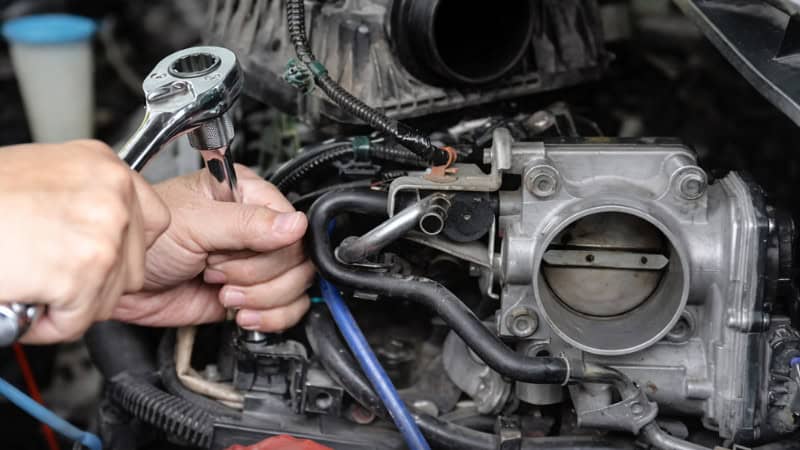
What Is a Throttle Position Sensor?
A TPS reports throttle position to the ECU, which regulates the fuel-air ratio. When pressed, it signals the addition of fuel for smooth acceleration.
The throttle sensor sends a changing voltage to the ECU as the throttle moves. If the sensor’s signal becomes inaccurate, the ECU may mismanage fuel, resulting in poor acceleration, a rough idle, or a check engine light.
Proper TPS calibration ensures the ECU manages performance correctly. Misalignment causes delayed throttle response, so a TPS reset is often needed after repairs or battery replacement. The sensor mounts on the throttle body near the plate shaft to track movement and provide feedback.
Symptoms of a Bad or Misaligned Throttle Position Sensor
A failing or misaligned TPS sends incorrect signals to the ECU, leading to issues like poor throttle response or warning lights. Early detection helps avoid more problems.
Common symptoms of a bad or misaligned throttle position sensor include:
- Poor acceleration – The vehicle may feel sluggish or slow to respond when pressing the gas pedal.
- Rough idle – The engine may idle unevenly or feel unstable when the car is stopped.
- Engine hesitation – The engine may hesitate or stumble when accelerating.
- Check engine light – A warning light may appear when the ECU detects abnormal TPS signals.
- Transmission shifting problems – Automatic transmissions may shift late, early, or harshly.
- Sudden RPM fluctuations – The engine speed may randomly increase or decrease.
- Reduced fuel economy – Incorrect throttle data can cause the engine to burn more fuel than necessary.
Vehicles may store codes like P0120, P0121, P0122, and P0123 for TPS issues. These mean the TPS may need recalibration, cleaning, or replacement.
Can You Reset a Throttle Position Sensor Without a Scanner?
Many cars, such as Honda, Ford, Lexus, Jeep, Audi, and Ford Ranger, allow a TPS reset without a scanner. A manual method, like disconnecting the battery, often triggers the ECU to relearn. Mechanics try these before using scanners or replacing the sensor.
Disconnecting the negative battery cable for several minutes resets the ECU, allowing the system to relearn throttle sensor values. This helps clear temporary electronic errors or adaptive data affecting the TPS.
Another way is to let the engine idle without touching the accelerator. The ECU uses this time to recalibrate the TPS. Some newer models need a scan tool, but many accept manual resets.
Method 1 – Reset TPS by Disconnecting the Battery
Disconnecting the battery resets the TPS. This clears ECU memory to help it relearn the throttle sensor values. Mechanics use this after throttle or sensor work.
To reset the TPS using the battery method, follow these steps: Turn off the ignition and remove the key.
- Next, open the hood and find the car battery.
- Using a wrench, disconnect the negative battery terminal.
- Wait 5–15 minutes for the ECU memory to reset.
- Reconnect the negative battery terminal securely to restore power.
- Turn the ignition ON without starting the engine.
- Wait 10–15 seconds for the ECU to start relearning.
- Start the engine and let it idle for several minutes.
Disconnecting the battery resets the ECU. Reconnecting power lets the ECU recalibrate key sensors, such as the TPS, often restoring throttle response and smooth operation.
Method 2 – Ignition Key Reset Procedure
Another easy way to reset the throttle position sensor without special tools is to use the ignition key reset procedure. This process allows the ECU to detect the throttle position during the ignition cycle and recalibrate the throttle control system. Many modern vehicles automatically perform a throttle relearn routine when the ignition is turned on and off several times.
- To perform the ignition key reset, do the following: Insert the key into the ignition.
- Turn the ignition to ON without starting the engine.
- Wait 10 seconds for the ECU to detect throttle position.
- Turn the ignition OFF to complete the cycle.
- Repeat these ON-OFF cycles two or three times.
- After the last cycle, start the engine as usual.
The ECU checks throttle position during ignition cycles and can recalibrate the sensor. Repeating the ignition process can resolve minor TPS issues.
Method 3 – Idle Relearn Procedure
Another effective way to reset the throttle position sensor without a scanner is by performing an idle relearn procedure. Many vehicles allow the engine control unit (ECU) to recalibrate the throttle position and idle airflow automatically while the engine is idling. This process is commonly used after cleaning the throttle body, disconnecting the battery, or replacing related components.
For idle relearn, start the engine and let it run normally.
- Do not press the accelerator pedal during the idle period.
- Let the engine idle for 3–5 minutes for ECU monitoring.
- Turn off the engine after this idle period ends.
- Restart the engine and check throttle response gently.
While the engine idles, the ECU adjusts the TPS based on sensor readings. This process helps restore good throttle response and smooth idle.
Method 4 – Accelerator Pedal Reset Procedure
Some vehicles can recalibrate the TPS using the accelerator pedal, prompting the ECU to learn the full throttle range.
- To reset with the accelerator pedal: Turn the ignition ON without starting.
- Slowly press the accelerator pedal fully down.
- Slowly release the pedal to its original position.
- Turn the ignition OFF to complete the process.
- Start the engine and test throttle response.
This procedure works because electronic throttle systems rely on sensors to track pedal position and throttle plate movement. When the accelerator pedal is pressed and released during the ignition cycle, the ECU records the full throttle range and recalibrates the throttle position sensor accordingly. This electronic throttle relearn process helps ensure that the ECU correctly interprets throttle inputs, resulting in smoother acceleration and more accurate engine control.
When TPS Reset Does Not Work
Sometimes resetting the throttle position sensor (TPS) does not solve the problem. If the vehicle continues to exhibit poor acceleration, a rough idle, or throttle response issues after a reset, the problem may be due to other mechanical or electrical faults. In these situations, further inspection of the throttle system and related components is necessary.
One possible cause is a faulty throttle position sensor. Over time, the sensor’s internal electronics can wear out or fail, resulting in inaccurate voltage signals sent to the engine control unit (ECU). Another common issue is a dirty throttle body. Carbon deposits and dirt can accumulate around the throttle plate, preventing it from opening and closing smoothly. This can confuse the sensor, leading to incorrect throttle readings. Wiring issues can also create TPS problems. Damaged wires, loose connectors, or corrosion in the wiring harness may disrupt signal transmission between the sensor and the ECU. In rare cases, the problem may originate with the engine control unit, especially if the ECU cannot properly interpret sensor data.
Before replacing the sensor, it is highly recommended to clean the throttle body using a proper throttle body cleaner. Removing carbon buildup can often restore normal throttle movement and correct TPS readings. Many mechanics perform throttle body cleaning as a first step before replacing any electronic components.

How to Test the Throttle Position Sensor
If you suspect the throttle position sensor is faulty, testing it with a multimeter is one of the most reliable ways to diagnose the problem. This test allows you to measure the voltage signal coming from the sensor and verify whether it changes correctly as the throttle opens and closes.
Start by locating the TPS on the throttle body and identifying the signal wire using a wiring diagram. Turn the ignition ON without starting the engine. Using a digital multimeter, measure the voltage between the TPS signal wire and ground. At the closed throttle position, the sensor should typically produce a voltage reading of around 0.5 volts. As you slowly open the throttle plate, the voltage should increase smoothly without any sudden jumps or drops.
At full throttle, the voltage usually rises to around 4.0 to 4.5 volts. This gradual change in voltage confirms that the sensor is operating properly. If the voltage remains fixed, fluctuates erratically, or falls outside the normal 0.5V–4.5V range, the throttle position sensor may be defective and should be replaced.
Cost to Replace a Throttle Position Sensor
Replacing a throttle position sensor is generally not an expensive repair compared to many other engine components. In the United States, the cost varies depending on the vehicle make and model, and whether you perform the repair yourself or have a professional mechanic do it.
Typically, the sensor itself costs between $40 and $150, depending on the brand and vehicle type. Labor costs can range from $80 to $200, since the replacement process usually takes less than an hour for most vehicles. In total, the average repair cost usually falls between $120 and $350.
For DIY car owners, replacing the TPS can be even more affordable because you only need to purchase the sensor. Since the component is usually mounted directly to the throttle body and held in place by a few screws, it is considered one of the easier automotive repairs.
Pro Tips Mechanics Use for TPS Reset
Professional mechanics often follow a few simple best practices when resetting or servicing a throttle position sensor. No matter if you’re working on a Honda, Ford, Lexus, Audi, Jeep, or Ford Ranger, these steps help prevent further issues and ensure the sensor works correctly after maintenance.
- Clean the throttle body first to remove carbon buildup that may affect throttle movement.
- Disconnect the battery before unplugging the sensor to prevent electrical damage.
- Inspect the wiring harness for loose connectors, broken wires, or corrosion.
- Reset the ECU after installing a new sensor so the engine computer can relearn the correct throttle position.
Following these tips can help improve the success rate of TPS resets and prevent unnecessary part replacements.
Final Thoughts
Resetting a throttle position sensor without a scanner is often possible using simple methods such as the battery disconnect procedure, an ignition cycle reset, an idle relearn, or an accelerator pedal relearn. These techniques allow the vehicle’s ECU to recalibrate the throttle sensor and restore normal throttle response without specialized diagnostic equipment.
However, if the problem continues after performing these reset procedures, the throttle position sensor itself may be faulty, or there may be other underlying issues, such as a dirty throttle body or wiring problems. Regular maintenance, including cleaning the throttle body and checking sensor connections, can help keep the throttle system working properly.
By understanding how the TPS works and how to reset it correctly, drivers and DIY mechanics can improve throttle response, maintain better fuel economy, and ensure smoother overall engine performance.
