
Advanced Driver Assistance Systems (ADAS) use sensors, cameras, and radar to help drivers avoid accidents. Features include lane keep assist, adaptive cruise control, blind-spot monitoring, and automatic emergency braking. By monitoring the road and surroundings, ADAS reduces errors and boosts vehicle safety.
If there’s a problem, your ADAS system will show fault codes to warn that a feature isn’t working right. These codes highlight failures in driver assistance functions. Common signs include dashboard warnings or disabled features, which can affect safety and performance.
Understanding ADAS fault codes is key to safe vehicle use. This guide covers common codes, their causes, basic troubleshooting, and ways to fix the system. We’ll also suggest useful diagnostic tools for repairs.
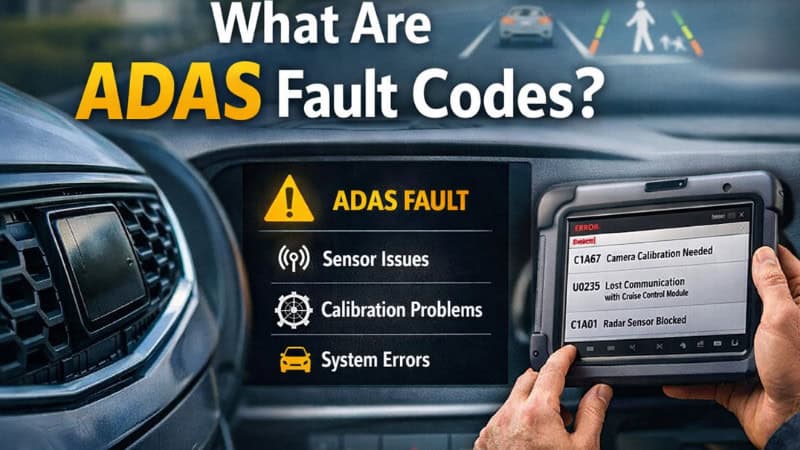
What Are ADAS Fault Codes?
ADAS fault codes are diagnostic trouble codes triggered by problems in your vehicle’s Advanced Driver Assistance Systems. Stored in the onboard computer, these codes identify issues with features such as adaptive cruise control, lane-keeping assist, collision avoidance, and more. Unlike traditional OBD2 codes, ADAS codes focus on sensors, cameras, and control modules that support advanced safety technology.
Standard OBD2 codes primarily address the engine, transmission, and emissions systems. ADAS-specific codes provide deeper insight into safety technology and often need advanced scan tools, as they communicate across several modules. Basic OBD2 scanners may only show generic faults, but a professional ADAS diagnostic tool accesses detailed data, calibrates sensors, and performs resets.
ADAS systems rely on several key components, including radar sensors (for distance detection and adaptive cruise control), cameras (for lane tracking and object recognition), ultrasonic sensors (for parking assist), and electronic control modules that process this data in real time. If any of these components malfunction, become misaligned, or lose communication, the system will trigger an ADAS fault code to alert the driver.
Common ADAS Fault Codes and What They Mean
Below is a quick-reference table of common ADAS fault codes. These codes can vary slightly by manufacturer, but the meanings are generally similar across most vehicles.
| C1101 | Radar Sensor | Misalignment detected |
| C1A67 | Camera | Calibration required |
| U0235 | Communication | Lost connection with the cruise control module |
| B2A60 | Parking Assist | Sensor blocked or dirty |
| C1A10 | Front Camera | Visibility obstruction |
| C1A01 | Radar System | Radar sensor blocked or contaminated |
| C1A02 | Radar System | Incorrect radar aiming/alignment |
| U3000 | Control Module | Internal control module fault |
| C1001 | ABS/ADAS System | Brake control system communication error |
| B2A61 | Parking Assist | Ultrasonic sensor malfunction |
| C1A20 | Lane Assist | Lane camera signal error |
| U0121 | Communication | Lost communication with the ABS module |
| C1A70 | Camera System | Camera initialization failure |
| B2A63 | Parking Assist | Sensor circuit failure |
These codes pinpoint the problem’s source—whether a blocked sensor, misalignment, wiring issue, or electronic failure. Accurate diagnosis with a professional scan tool is essential for fast repairs and the restoration of all assist features.
What Causes ADAS Fault Codes?
ADAS fault codes occur when system components malfunction or receive incorrect data. Blocked or dirty sensors—from mud, snow, rain, or road grime—are common causes, as they hinder radar and camera function. Even minor obstructions can trigger errors and disable features such as adaptive cruise control or lane-keep assist.
Physical damage also contributes. Minor accidents, bumper impacts, or misalignment affect radar sensors behind the bumper or grille. Windshield replacement can misalign cameras if not recalibrated. These systems depend on precision, so even slight misalignment can trigger fault codes and reduce accuracy.
Electrical and software issues also cause ADAS errors. Damaged wiring, loose connectors, or low battery voltage can disrupt communication between the control module. Outdated firmware or software glitches can trigger false codes. Use a professional scan tool to identify mechanical, electrical, or software issues.
Symptoms of ADAS System Problems
When your vehicle starts showing ADAS system problems, it usually means that one or more safety features are no longer working as they should. Since ADAS controls systems like lane assist, adaptive cruise control, forward collision warning, and automatic emergency braking, even a small fault can affect both safety and driving comfort. In many cases, the issue starts with a dashboard warning light, but sometimes the system may stop working without much notice. That’s why it’s important to understand the common symptoms early, so you can diagnose the problem before it gets worse.
Dashboard Warning Light
One of the most common signs of an ADAS issue is a dashboard warning light or alert message. You may see messages like “ADAS Fault,” “Front Assist Unavailable,” or “Camera Blocked.”
This is the vehicle’s way of telling you that one of the safety systems is not operating correctly and needs attention.
Adaptive Cruise Control Not Working
If there is a fault in the radar sensor or control module, the adaptive cruise control may stop working completely. In some cases, it may turn on but fail to maintain the proper distance from the vehicle ahead.
This can make highway driving less comfortable and reduce one of the key safety benefits of the ADAS system.
Lane Keep Assist Disabled
Lane keep assist may suddenly turn off if the front camera cannot read the road properly or if the system needs calibration. This often happens after windshield replacement, camera obstruction, or sensor misalignment.
When this feature is disabled, the vehicle can no longer provide steering assistance to help keep you in your lane.
Automatic Emergency Braking Unavailable
A serious ADAS fault can disable the automatic emergency braking system, leaving the car unable to react properly to sudden obstacles or vehicles ahead.
This reduces your vehicle’s ability to help prevent or reduce the impact of a collision, especially in emergency situations.
False Alerts While Driving
Sometimes the ADAS system may start giving warnings even when there is no actual danger on the road. You may hear random collision alerts, lane departure warnings, or unnecessary beeping.
This usually points to a camera, radar, or software issue that is causing the system to read incorrect data.
Parking Assist Malfunction
If the ultrasonic sensors are dirty, damaged, or disconnected, the parking assist system may stop properly detecting nearby objects. It may also give false warnings while parking.
This can make parking more difficult and increase the risk of minor bumps or misjudging tight spaces.
How to Diagnose ADAS Fault Codes
When ADAS errors appear, use a step-by-step approach to diagnose the issue. Multiple sensors and modules work together, so guessing won’t work. A quick scan and basic check can save money if the problem is minor.
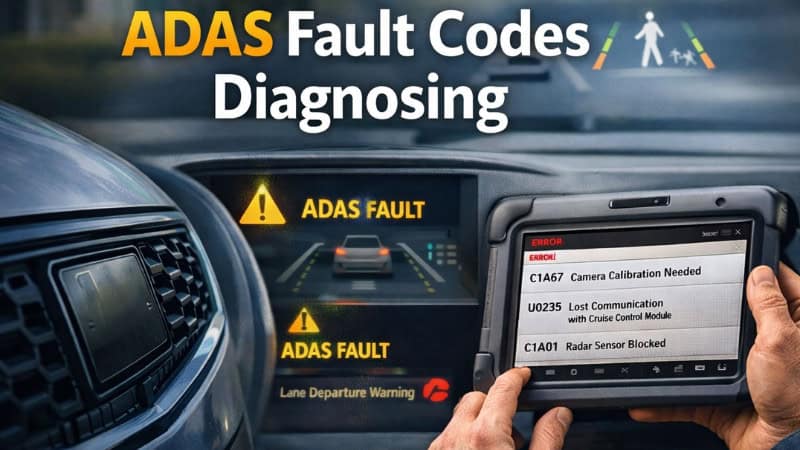
Use an Advanced OBD2 Scanner
Start by connecting a professional scan tool that supports ADAS systems. Basic scanners may not show detailed ADAS fault codes or live data.
A proper scanner helps you identify the exact problem area, whether it’s the radar, the camera, or the control module.
Read Stored and Pending Codes
Check both stored and pending fault codes to understand current and potential issues. Some problems may not trigger a warning light immediately, but are still recorded in the system.
This step provides clear direction before you start any physical inspection or repair.
Check Live Sensor Data
Use the scanner to monitor real-time data from sensors like radar and cameras. Look for irregular readings or signal loss.
Abnormal values can quickly point you to a faulty or misaligned component.
Inspect Sensors and Cameras Physically
Visually check all sensors for dirt, mud, water, or physical damage. Even a small obstruction can cause the system to malfunction.
Also, inspect the mounting positions to ensure nothing is loose or misaligned.
Check Wiring and Connections
Look for damaged wires, loose connectors, or corrosion around ADAS components. Electrical issues are a common cause of fault codes.
A poor connection can interrupt communication between modules and trigger errors.
Perform Calibration Check
If everything looks fine but the issue remains, the system may need calibration. This is especially common after windshield replacement or minor accidents.
Proper calibration ensures that sensors and cameras are correctly aligned and working as intended.
How to Fix ADAS Fault Codes
Fixing ADAS fault codes requires a systematic approach because these systems depend on precise sensor data and accurate calibration. Unlike basic engine issues, ADAS faults are often linked to alignment, visibility, or communication between multiple modules. In many cases, the fix is simple, but ignoring the root cause can lead to recurring errors or disabled safety features.
Clean Sensors and Cameras
Dirt, dust, snow, or water buildup on radar sensors and cameras is one of the most common causes of ADAS faults. Carefully clean all sensor surfaces using a soft cloth and appropriate cleaner.
Even a thin layer of grime can block signals, trigger warning codes, or disable features.
Check and Repair Wiring Issues
Inspect wiring harnesses, connectors, and terminals for any signs of damage, corrosion, or loose connections. Electrical faults can interrupt communication between ADAS modules.
Repairing or securing connections can often resolve fault codes without replacing expensive components.
Reset the System
After performing basic checks, use a diagnostic scanner to clear the fault codes. In some cases, disconnecting the battery for a few minutes may also reset the system.
However, if the underlying issue is not fixed, the code will return shortly after.
Perform ADAS Calibration
Calibration is required when sensors or cameras are misaligned, especially after windshield replacement, collision repair, or component replacement.
This process can be static (done in a workshop) or dynamic (performed while driving), ensuring all systems are properly aligned.
Replace Faulty Components
If a sensor, camera, or control module is defective, replacement may be necessary. Always use OEM or high-quality parts to maintain system accuracy.
After replacement, calibration is usually required to restore full functionality.
Update Software or Firmware
Some ADAS issues are caused by outdated software or system glitches. Updating the vehicle’s software through a dealer or professional tool can fix hidden bugs.
This step is often overlooked but can resolve persistent or random fault codes.
ADAS Calibration Explained
ADAS calibration is the process of precisely aligning your vehicle’s sensors and cameras so they can accurately detect the road, lane markings, and surrounding traffic. Since these systems rely on exact positioning, even a small misalignment can cause incorrect readings or trigger fault codes. This directly affects features like lane keep assist, adaptive cruise control, and automatic emergency braking.
There are two main types of calibration: static and dynamic. Static calibration is performed in a workshop using specialized targets and equipment while the vehicle remains stationary. Dynamic calibration, on the other hand, is done while driving under specific conditions, allowing the system to recalibrate using real-world data from the road.
Calibration is usually required after windshield replacement, collision repairs, suspension work, or sensor replacement. Without proper calibration, ADAS features may not function correctly or may give false warnings. That’s why recalibrating the system after any related repair is essential to maintain accuracy, safety, and overall vehicle performance.
Can You Drive With ADAS Fault Codes?
Driving with ADAS fault codes is usually possible, but it’s not recommended for long periods. When these codes appear, it means one or more advanced safety features are either limited or completely disabled. Your vehicle will still operate normally in terms of engine and basic driving functions, but you lose the extra layer of protection that ADAS systems provide.
In many cases, features like adaptive cruise control, lane keep assist, blind-spot monitoring, or automatic emergency braking may stop working. This increases the risk of accidents, especially on highways or in heavy traffic, where these systems are most helpful. Some vehicles may also enter a restricted mode, limiting certain functions until the issue is resolved.
If you see ADAS fault warnings, it’s best to diagnose and fix the problem as soon as possible. While the car may still be drivable, ignoring these codes can compromise safety and lead to more expensive repairs later. Addressing the issue early ensures your vehicle’s safety systems are fully operational when you need them most.
How to Prevent ADAS Fault Codes
Preventing ADAS fault codes is all about maintaining sensor accuracy and protecting the components that support these advanced safety systems. Since ADAS relies heavily on clear visibility and precise alignment, even minor issues such as dirt buildup or minor impacts can lead to system errors. Regular care and attention can help you avoid unexpected warnings and keep all features working smoothly.
Keep Sensors Clean
Regularly clean radar sensors and cameras to remove dirt, dust, snow, or water buildup. Even a small obstruction can block signals and trigger fault codes.
Make it a habit to check sensor areas, especially after driving in bad weather or muddy conditions.
Avoid Bumper Damage
Many ADAS sensors are mounted behind the front and rear bumpers. Even minor impacts or scratches can misalign these sensors.
Always inspect for hidden damage after a small accident or parking hit, as misalignment may not be visible.
Perform Regular Diagnostic Checks
Periodically scanning your vehicle can help detect early issues before they become serious problems. Some faults may not show immediate warning signs.
Early detection can save you from costly repairs and prevent sudden system failures.
Use Proper Windshield Replacement Procedures
If your windshield is replaced, ensure ADAS calibration is performed properly. The front camera is usually mounted on the windshield and must be aligned correctly.
Skipping calibration after replacement can lead to persistent fault codes and malfunctioning safety features.
FAQs About ADAS Fault Codes
What is the most common ADAS fault code?
One of the most common ADAS fault issues is misalignment of radar or camera systems, often triggered by dirt, weather conditions, or minor impacts. Codes related to sensor blockage or calibration are frequently seen across many vehicles.
These issues usually appear after driving in harsh conditions or after repairs like windshield replacement, and they often require simple cleaning or recalibration.
Can I reset ADAS fault codes without a scanner?
In some cases, you may clear temporary ADAS faults by disconnecting the battery, but this is neither reliable nor recommended. Most ADAS codes require a proper diagnostic tool to reset and verify.
Without fixing the root cause, the code will return, and some systems may remain disabled even after a reset.
How much does ADAS calibration cost?
The cost of ADAS calibration can vary depending on the vehicle and the type of calibration required. Typically, it ranges from moderate to expensive due to the specialized equipment involved.
Static calibration usually costs more than dynamic calibration, especially when multiple sensors or systems are involved.
Why do ADAS errors appear after windshield replacement?
The front-facing camera is usually mounted on the windshield, and replacing it can disrupt its alignment. Without proper recalibration, the system may not accurately read the road.
This leads to fault codes, disabled features, or inaccurate warnings, making calibration essential after any windshield work.
Conclusion
Advanced Driver Assistance Systems (ADAS) play a critical role in modern vehicle safety, helping drivers avoid accidents through features like adaptive cruise control, lane assist, and automatic emergency braking. When ADAS fault codes appear, they are not just technical alerts—they are warnings that your vehicle’s safety systems may not be fully operational. Ignoring these issues can lead to reduced protection on the road and increase the risk of unexpected failures.
That’s why early diagnosis is essential. Whether it’s an ADAS warning light, a radar sensor error, or a lane assist not working, identifying the problem quickly can prevent more serious damage and costly repairs. Regular checks, proper scanning, and understanding the signs of ADAS system malfunctions can make a big difference in maintaining your vehicle’s performance and safety.
To keep your ADAS system working at its best, always use the right diagnostic tools and follow proper calibration procedures after any repair or replacement. Investing in correct maintenance and timely fixes ensures your vehicle’s advanced safety features remain reliable, accurate, and ready when you need them most.
