
Modern cars are smarter than ever—almost like having a co-driver watching the road with you. That’s where Advanced Driver Assistance Systems (ADAS) come in. In simple terms, ADAS is a group of smart safety technologies that use cameras, sensors, and radar to help you avoid accidents, stay in your lane, and drive more confidently.
For everyday drivers, these safety features aren’t just high-tech extras—they lower crash risks, reduce insurance costs, and make driving easier. In 2026, AI-powered ADAS systems will get even smarter: faster, more accurate, and more reliable than ever before.
In this guide, we’ll break down the top ADAS features in 2026 cars, how they actually work in real-world driving, and which ones are truly worth having in your vehicle.
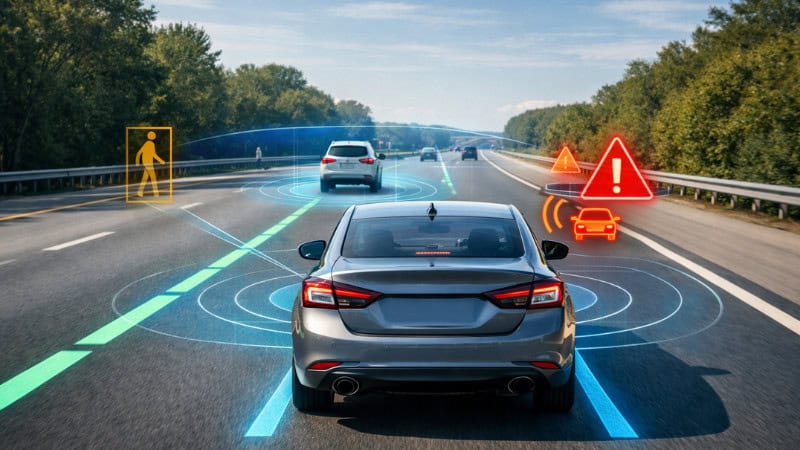
What Is ADAS and How Does It Work?
Advanced Driver Assistance Systems (ADAS) are designed to make driving safer and easier by combining cameras, radar, sensors, and smart software to monitor what’s happening around your vehicle in real time. These systems constantly collect data, process it instantly, and then either warn the driver or take action—like braking or steering—to help prevent accidents.
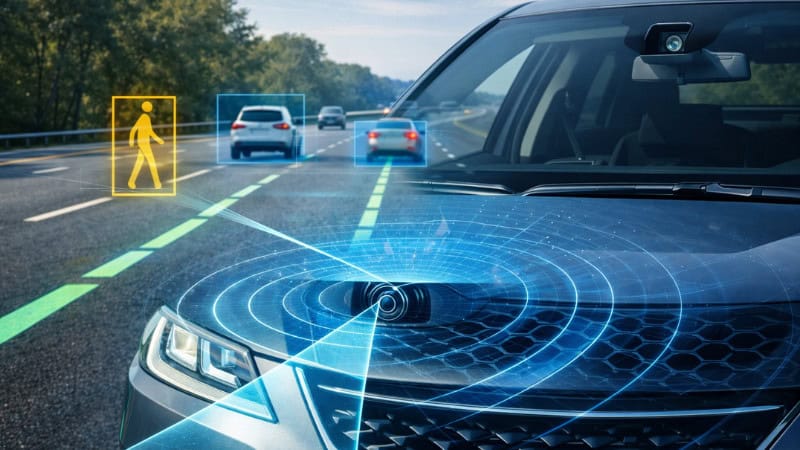
Modern driver assistance systems rely on several types of sensors working together:
- Cameras: Usually mounted on the windshield or around the vehicle, they detect lane markings, road signs, pedestrians, and other vehicles.
- Radar sensors: Great for measuring distance and speed, especially useful in features like adaptive cruise control and collision avoidance.
- LiDAR (Light Detection and Ranging): Found in some premium vehicles, it creates a detailed 3D map of surroundings for higher accuracy.
- Ultrasonic sensors: Typically used for parking assist and close-range object detection.
Here’s a real-world example: when you’re drifting slightly out of your lane, lane keeping assist uses cameras to detect lane markings and can gently adjust the steering to guide you back—helping prevent unintended lane departure.
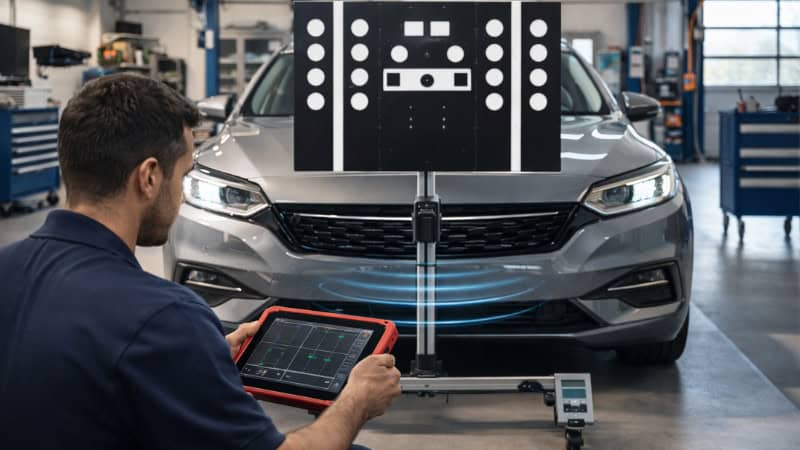
One thing many drivers overlook is ADAS calibration. After repairs like a windshield replacement, suspension work, or even a minor collision, these sensors can lose alignment. If calibration isn’t done properly, your car safety technology may give incorrect warnings—or worse, fail when you need it most.
Why ADAS Features Matter in 2026
Let’s be real—roads aren’t getting any safer. With more traffic, distracted driving, and longer commutes, having advanced driver assistance systems in your vehicle is no longer a luxury—it’s becoming a necessity.
In 2026, automakers are doubling down on car safety technology, and for good reason. Many newer vehicles now come equipped with ADAS safety features as standard, thanks to stronger safety regulations and growing demand from drivers who want extra protection behind the wheel.
For everyday drivers, these systems can make a big difference. Features like automatic braking and blind-spot monitoring help reduce accident risk, while tools like adaptive cruise control make highway driving less stressful. On top of that, many U.S. insurance companies offer discounts for vehicles equipped with driver assistance systems, since they reduce the likelihood of costly claims.
Bottom line—ADAS isn’t just about convenience anymore. It’s about safer driving, smarter vehicles, and giving you an extra layer of protection every time you hit the road.
Top ADAS Features in 2026 Cars (Detailed Breakdown)
Modern vehicles offer many advanced driver assistance systems, but not all are created equal. Some are essential for safety, while others add convenience. Let’s break down the ones that truly make a difference in 2026 cars.
Automatic Emergency Braking (AEB)
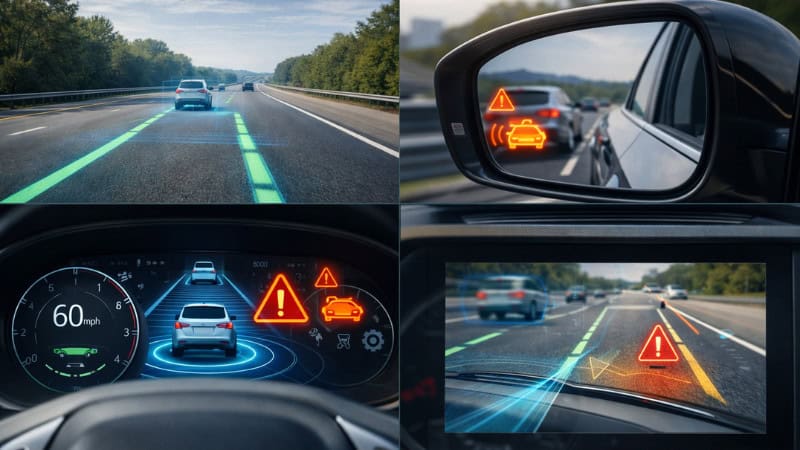
This is one of the most important ADAS safety features you can have. Automatic emergency braking uses cameras and radar to detect a potential collision ahead. If the system senses you’re not reacting in time, it can automatically apply the brakes to reduce impact—or avoid the crash completely.
In real-world driving, this is a lifesaver in stop-and-go traffic or when a car suddenly brakes in front of you.
Adaptive Cruise Control (ACC) with Stop & Go
Adaptive cruise control measures the distance to the vehicle ahead and maintains a set gap, while stop-and-go allows your car to come to a full stop and restart in traffic—a step beyond standard cruise control.
This feature is a game-changer for highway driving and long commutes, reducing fatigue and making driving smoother.
Lane Keeping Assist (LKA) & Lane Departure Warning (LDW)
These driver assistance systems help keep your vehicle centered in its lane. If you drift without signaling, the lane departure warning alerts you with an audible or visual signal, while lane keeping assist can then gently steer the car back into position.
Perfect for highway trips where driver fatigue can become a real issue.
Blind Spot Monitoring (BSM)
Changing lanes becomes much safer with blind-spot monitoring. Unlike lane departure warning, which alerts you if you unintentionally drift out of your lane, this system specifically detects vehicles in your blind spots and alerts you—usually with a warning light in the mirror or an audible signal.
It’s one of those car safety features you don’t realize you need… until it saves you from a side-swipe accident.
Rear Cross Traffic Alert (RCTA)
Backing out of a parking spot? A rear cross-traffic alert is a safety feature that detects vehicles approaching from the sides as you reverse and warns you before a collision.
Super useful in crowded parking lots where visibility is limited.
360-Degree Camera System
This system gives you a bird’s-eye view of your vehicle using multiple cameras. It makes tight parking and maneuvering in small spaces much easier and safer.
For many drivers, this is one of the most practical ADAS features for everyday use.
Traffic Sign Recognition (TSR)
Traffic sign recognition uses cameras to detect various types of road signs, such as speed limits and stop signs, and displays each type separately on your dashboard.
It helps drivers stay aware of changing road conditions—especially useful when driving in unfamiliar areas.
Driver Monitoring System (DMS)
This system keeps an eye on you. It detects signs of drowsiness or distraction and alerts you if you’re not paying attention.
With distracted driving on the rise, this is becoming a key part of modern driver assistance systems.
Highway Driving Assist / Semi-Autonomous Driving
This combines multiple ADAS technologies, such as adaptive cruise control and lane centering, to provide semi-autonomous driving support.
It’s not self-driving—but it takes a lot of stress out of highway driving by assisting with steering, braking, and acceleration.
These top ADAS features in 2026 cars are designed to work together, creating a smarter, safer driving experience. Up next, we’ll look at the newest and most advanced ADAS technologies shaping the future.
New & Trending ADAS Technologies in 2026
ADAS is evolving fast—and in 2026, we’re seeing smarter, AI-driven systems that go beyond basic safety. These next-gen advanced driver assistance systems are designed to predict problems before they happen, not just react to them.
AI-Powered Predictive Braking
Unlike traditional systems, this advanced version of automatic emergency braking uses AI to analyze driving patterns and traffic behavior. It can predict potential hazards earlier and react faster, making it one of the most advanced car safety technologies available today.
Intersection Collision Avoidance
This feature is designed for one of the most dangerous driving scenarios: intersections. It detects cross traffic, pedestrians, and oncoming vehicles when turning, and can apply brakes if a collision risk is detected.
A huge upgrade for urban driving where accidents are more common.
Enhanced Night Vision Systems
Using infrared cameras, these systems can detect pedestrians, animals, or obstacles in low-light conditions long before your headlights reveal them.
For night driving, this is a serious safety boost and one of the fastest-growing ADAS features in premium vehicles.
Vehicle-to-Vehicle (V2V) Communication
This is where things get futuristic. Vehicles can now “talk” to each other, sharing real-time data about speed, position, and road hazards.
For example, if a car ahead suddenly brakes or hits ice, your vehicle can receive that info instantly—improving reaction time and reducing accident risk.
Over-the-Air (OTA) ADAS Updates
Just like your smartphone, modern vehicles now receive OTA updates that improve system performance over time. Automakers can update driver assistance systems, fix bugs, and even add new features without you visiting a dealership.
These innovations are taking ADAS safety features to the next level—making vehicles safer and smarter with every mile.
You might be wondering which cars already use these systems. Let’s look at some examples on the road today.
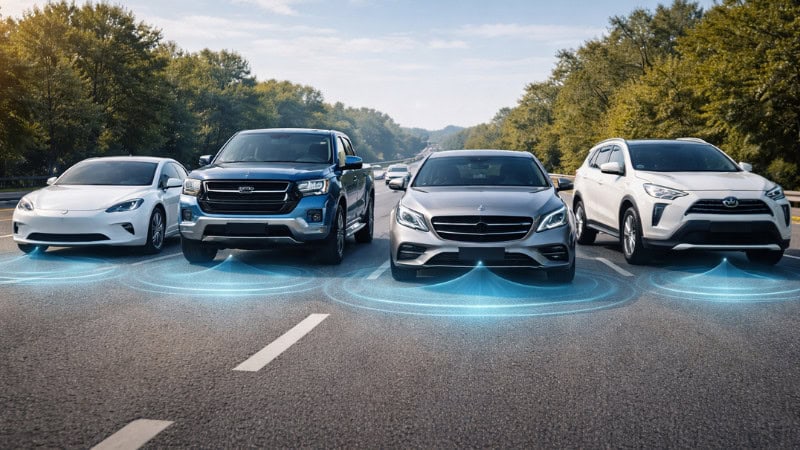
Many modern vehicles now come standard with advanced driver assistance systems. Here are a few examples:
- Tesla Model 3 – Tesla’s vehicles feature Autopilot and Full Self-Driving, which are among the most advanced ADAS systems available. These provide lane-centering, adaptive cruise control, and automatic lane changes.
- Ford F-150 – With Ford Co-Pilot360, the F-150 includes features like lane-keeping assist, adaptive cruise control, and pre-collision assist—perfect for both city and highway driving.
- Mercedes-Benz S-Class – The S-Class is a leader in luxury ADAS, offering AI-powered adaptive cruise, active lane change assist, and traffic jam assist.
- Toyota RAV4 – Toyota’s Safety Sense suite provides automatic emergency braking, lane departure alert, and adaptive cruise control as standard on many trims.
With ADAS becoming increasingly common, from Teslas to Toyotas, there’s an ADAS-equipped vehicle out there for every kind of driver.
Pros and Cons of ADAS Features
Like any technology, advanced driver assistance systems have both advantages and drawbacks. Understanding both sides helps you decide which ADAS features are truly worth it for your driving needs.
Pros:
- Improved Safety: The biggest benefit of ADAS safety features is reducing accident risk. Systems such as automatic emergency braking and blind-spot monitoring actively help prevent collisions.
- Reduced Driver Fatigue: Features like adaptive cruise control and lane keeping assist take some of the stress out of long drives, especially on highways.
- Insurance Benefits: Many U.S. insurance providers offer discounts for vehicles equipped with car safety technology, since they lower the likelihood of claims.
- Better Resale Value: Cars with modern driver assistance systems are more attractive to buyers, which can boost resale value down the road.
Cons:
- Higher Repair & Calibration Costs: Fixing or replacing ADAS components isn’t cheap. Even a simple windshield replacement may require ADAS calibration, which adds extra cost.
- Sensor Limitations: Cameras and sensors can be affected by dirt, rain, fog, or snow—reducing the effectiveness of some ADAS features.
- Over-Reliance on Technology: Some drivers may rely too much on these systems, forgetting that they’re only assist features—not a replacement for safe driving.
Bottom line: ADAS systems offer major safety and convenience benefits, but they still require proper maintenance—and a fully attentive driver behind the wheel.
Common ADAS Problems & Warning Signs
Even though advanced driver assistance systems are built for safety, they’re not immune to issues. When something goes wrong, your ADAS features may not work properly—or worse, give false warnings. Here are the most common problems and signs every driver should watch for.
ADAS Warning Lights on the Dashboard
If you see an ADAS-related warning message or icon, don’t ignore it. It usually means a sensor, camera, or driver assistance system isn’t functioning correctly.
Blocked or Dirty Sensors
One of the most common causes of ADAS issues is something as simple as dirt. Mud, snow, or even bugs on cameras and sensors can block their view.
This can affect features like:
- Lane keeping assist
- Automatic emergency braking
- Blind spot monitoring
Keeping your sensors clean is critical to the proper performance of car safety technology.
Calibration Issues After Repairs
Anytime your car goes through:
- Windshield replacement
- Suspension work
- Alignment
- Collision repair
Your ADAS calibration may be thrown off. Even a slight misalignment can cause systems to misread the road or nearby vehicles.
Inconsistent or Unexpected Behavior
If your ADAS systems are:
- Braking too early
- Not detecting vehicles properly.
- Giving random alerts
That’s a clear sign something isn’t right. These systems should work smoothly and consistently—not unpredictably.
Sensor or Module Failure
Over time, components such as radar sensors and cameras can fail due to wear, impact, or electrical issues. This can disable certain ADAS safety features completely.
Pro Mechanic Tip: If you notice any of these warning signs, don’t wait. Scan the vehicle with a proper diagnostic tool and perform calibration if needed. Ignoring ADAS issues can compromise your road safety.
How to Maintain ADAS Systems (Mechanic Tips)
If you want your advanced driver assistance systems to work the way they’re supposed to, maintenance is key. These systems rely on precision—so even small issues can affect performance. Here’s how to keep your ADAS features in top shape.
Keep Sensors and Cameras Clean
Your driver assistance systems depend on clear visibility. Dirt, dust, snow, or even water spots can block sensors and cameras.
Quick tip: Regularly clean areas like the front camera (windshield), radar (bumper), and blind spot sensors (side mirrors).
Don’t Skip ADAS Calibration
Anytime your vehicle undergoes:
- Windshield replacement
- Wheel alignment
- Suspension repair
- Accident repair
You must perform ADAS calibration. Without it, your car’s safety technology may give inaccurate readings or fail completely.
Use Proper Diagnostic Tools
Modern ADAS systems require advanced scan tools for accurate diagnostics. A basic OBD2 scanner may not detect calibration or sensor-related issues.
Always use a professional-grade scanner when diagnosing ADAS problems.
Pay Attention to Warning Messages
If your dashboard shows an ADAS warning, don’t ignore it. These alerts are designed to tell you something isn’t working properly.
Ignoring them can lead to bigger issues—and reduce your vehicle’s safety.
Check After Harsh Driving Conditions
Driving through heavy rain, snow, or rough roads can affect sensors and alignment. After extreme conditions, it’s a good idea to visually inspect your sensors.
Pro Mechanic Advice: Treat your ADAS safety features like safety equipment—not convenience tools. A quick check and proper calibration can make the difference between avoiding an accident and being in one.
Which ADAS Features Are Worth It? (Buying Guide)
Not every driver needs every feature—but some ADAS features are absolutely worth having, no matter what you drive. The key is choosing the right driver assistance systems based on your driving style and daily conditions.
Best ADAS Features for City Driving
If you mostly drive in traffic, tight streets, and parking lots, focus on:
- Automatic emergency braking (AEB)
- Blind spot monitoring (BSM)
- Rear cross traffic alert (RCTA)
- 360-degree camera system
These car safety features help prevent low-speed collisions and make urban driving much easier.
Best ADAS Features for Highway Driving
For long commutes and highway trips, these are game changers:
- Adaptive cruise control (ACC)
- Lane keeping assist (LKA)
- Highway driving assist (semi-autonomous features)
They reduce fatigue and make long drives smoother and safer.
Must-Have vs Optional Features
Must-Have ADAS Features:
- Automatic emergency braking
- Blind spot monitoring
- Lane departure warning
Nice-to-Have (Optional):
- 360-degree camera
- Traffic sign recognition
- Night vision systems
These extra features improve convenience but aren’t essential for every driver.
Budget vs Premium Vehicles
- Budget Cars: Usually come with basic ADAS safety features, such as AEB and lane-departure warning. These are enough for everyday safety.
- Premium Vehicles: Offer advanced systems such as AI-powered ADAS, LiDAR, and semi-autonomous driving—ideal for tech-savvy drivers seeking the latest innovations.
Bottom Line: If you’re buying a car in 2026, don’t skip the basics. A few well-chosen advanced driver assistance systems can significantly improve your safety, driving comfort, and even your vehicle’s long-term value.
FAQs (Frequently Asked Questions)
Are ADAS features standard in 2026 cars?
In 2026, many ADAS features will become standard, especially in the U.S. market. Basic advanced driver assistance systems, such as automatic emergency braking (AEB), lane departure warning, and blind spot monitoring, are now commonly included even in entry-level vehicles. However, more advanced features such as 360-degree cameras, semi-autonomous driving, and night vision systems are still mostly found in mid-range to premium models. Automakers are continually expanding standard safety packages in response to stricter safety regulations and consumer demand. So while not every feature is standard yet, most new vehicles come equipped with essential car safety technology.
Can ADAS prevent accidents completely?
No—ADAS systems are designed to assist, not replace the driver. While features like automatic emergency braking and lane-keeping assist can significantly reduce accident risk, they can’t prevent every situation. Factors such as weather conditions, sensor limitations, and driver behavior still play a significant role. Think of driver assistance systems as an extra layer of safety—not a guarantee. You should always stay alert and keep full control of the vehicle. When used correctly, these systems can help prevent many common accidents, but safe driving habits remain the most important factor.
How much does ADAS calibration cost in the U.S.?
The cost of ADAS calibration in the U.S. typically ranges from $150 to $600, depending on the vehicle and system complexity. Basic calibrations (like a front camera) are usually on the lower end, while full-system calibrations involving radar and multiple sensors can cost more. If your vehicle requires both static and dynamic calibration, the price can increase further. It’s important to note that calibration is often required after windshield replacement, alignment, or collision repair. Skipping this step can lead to inaccurate readings and unsafe performance of ADAS features.
Do ADAS systems work in bad weather?
ADAS safety features can be affected by adverse weather conditions such as heavy rain, fog, or snow, as well as by dirt buildup. Cameras may struggle with visibility, and radar sensors can sometimes give reduced accuracy. For example, lane keeping assist may not detect faded or snow-covered lane markings. That said, newer car safety technology in 2026 is improving with better sensors and AI processing, making systems more reliable than before. Still, drivers should never rely completely on ADAS during harsh weather and should always be prepared to take full control.
Conclusion
Modern advanced driver assistance systems are transforming the way we drive—making vehicles safer, smarter, and easier to control in everyday situations. From automatic emergency braking to semi-autonomous highway driving, these technologies provide an extra layer of protection that every driver can benefit from.
But remember, even the best ADAS features require proper maintenance and calibration to perform correctly. If you notice any warning lights or unusual behavior, don’t ignore it—diagnose the issue early and keep your car safety technology working at its best.
Pro Tip: If your ADAS warning light is on, get it checked ASAP—because when it comes to safety, there’s no room for guesswork.
