
Modern vehicles use safety systems like ABS and TCS to help maintain control. ABS protects wheels from locking during hard braking, so you can steer. Traction control prevents wheel spin when accelerating on slippery surfaces.
These systems work together using shared components, such as wheel speed sensors and the ABS control unit. If one of these shared parts breaks, both systems can have problems.
That’s why both ABS and traction control lights often come on together. The vehicle may disable both as a safety measure if it detects a fault.
This guide focuses on the main shared causes of both lights coming on, how professionals diagnose these issues, and straightforward repairs involving the affected systems.
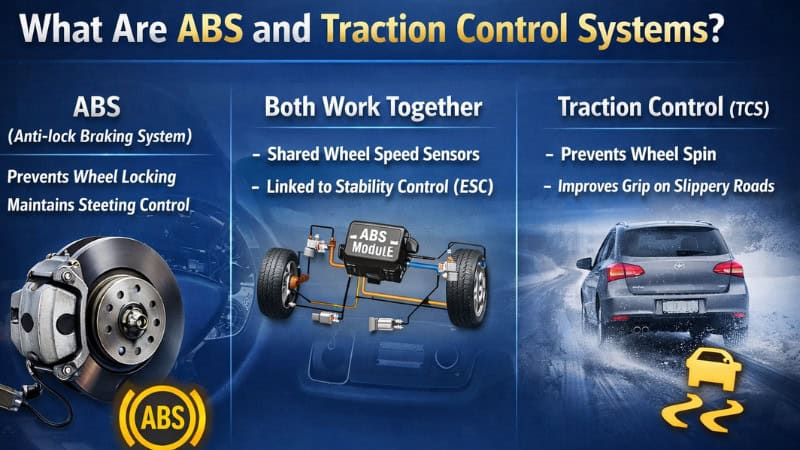
What Are ABS and Traction Control Systems?
Vehicles rely on ABS and TCS for challenging conditions. ABS helps maintain steering control under instant braking, and TCS reduces wheel slip when accelerating on slick roads.
ABS (Anti-lock Braking System)
ABS prevents wheels from locking during instant braking by pulsing brake pressure, allowing wheels to keep turning.
With ABS, you can still steer while braking, reducing the risk of skidding, especially on wet roads.
ABS uses sensors on each wheel, special valves to control brake pressure, and a small computer to check and manage braking.
Traction Control System (TCS)
TCS stops drive wheels from spinning during acceleration, which is useful on slippery surfaces like rain or snow.
Traction control checks wheel speeds using the ABS sensors. If one wheel spins too fast, it reduces engine power or gently applies brakes to stop the spin. This helps the car grip the road and stay steady.
Why ABS and Traction Control Work Together:
Because ABS and traction control share sensors and other components, a single faulty sensor or control unit can render both systems inoperable.
If a fault is detected, the computer disables ABS and traction control, lighting both warnings.
What Causes the ABS Light and Traction Control Light to Come On Together?
When both the ABS and traction control lights come on, the vehicle’s computer usually finds a problem with a part both systems use. One broken shared component, such as a sensor or control unit, can simultaneously shut off both safety features.
Below are the most common reasons these warning lights appear together.
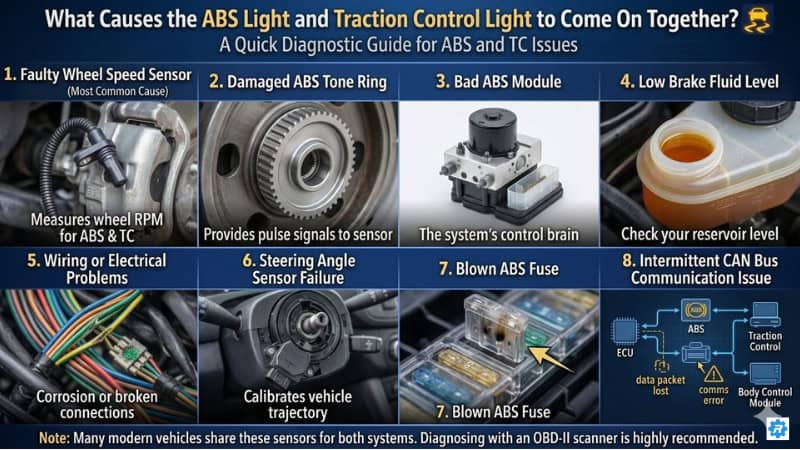
1. Faulty Wheel Speed Sensor (Most Common Cause)
Wheel speed sensors monitor rotation speed and send data to the ABS module.
A failed sensor means the system can’t control braking or traction, so both lights come on.
Common symptoms include:
- ABS and traction control lights on the dashboard
- Cruise control is not working properly.
- Speedometer fluctuations in some vehicles
2. Damaged or Rusted ABS Tone Ring
The ABS tone ring works with the wheel speed sensor and has small teeth that help measure wheel speed.
A rusted or damaged tone ring can confuse the system, leading to both warnings appearing.
Drivers may notice:
- Intermittent ABS or traction control warnings
- Pulsating brake pedal
- Warning lights that come and go while driving
3. Bad ABS Control Module
The ABS control unit reads sensor signals and controls the brakes during ABS use.
If the module fails, both ABS and traction control may stop working.
Symptoms often include:
- ABS and traction control lights are staying on constantly
- Multiple dashboard warning lights
- ABS not activating during hard braking
4. Low Brake Fluid Level
Low brake fluid levels trigger the ABS warning due to reduced hydraulic pressure.
When fluid levels are low, both the ABS and traction control lights may come on.
Signs of low brake fluid may include:
- Soft or spongy brake pedal
- Brake warning light along with ABS light
- Reduced braking performance
5. Wiring or Electrical Problems
Damaged ABS wiring stops signals; both systems may fail.
Common causes of wiring problems include:
- Rodents chewing vehicle wiring
- Corrosion from moisture or road salt
- Loose connectors near the wheel hubs
These issues can easily trigger both warning lights simultaneously.
6. Steering Angle Sensor Failure
The steering angle sensor measures the steering wheel’s position and helps control the car’s direction.
If this sensor fails or loses calibration, the traction control and stability control systems may not function properly. This can trigger dashboard warning lights, including the ABS and traction control lights.
Drivers may notice:
- Traction control warning light
- Stability control light
- ABS light appears simultaneously
7. Blown ABS Fuse
If the ABS fuse blows, the system shuts down.
Without power, both the ABS and traction control lights come on.
This is a simple issue, but it still requires inspection to determine why the fuse failed in the first place.
Is It Safe to Drive with ABS and Traction Control Lights On?
With both lights on, the vehicle is usually drivable, but safety systems may remain disabled until repaired.
Possible Risks (No ABS Protection)
With the ABS light on, ABS may not function, and steering during hard braking can be harder.
Wheels May Lock During Braking
Without ABS support, the wheels can lock up during sudden braking, especially on wet or slippery roads. When the wheels lock, the vehicle may skid, and the driver may lose steering control.
Reduced Traction on Slippery Roads
Disabled traction control can cause wheel spin on slippery roads, reducing stability.
Advice
You can usually drive briefly if brakes feel normal, but use caution, especially in poor weather.
Even if the car still operates, it is important not to ignore the warning lights. The safest approach is to diagnose and repair the issue as soon as possible. Fixing the problem quickly will restore the full functionality of your ABS and traction control systems, helping ensure maximum safety while driving.
How to Diagnose ABS and Traction Control Lights
When the ABS light and traction control light turn on together, the best way to identify the exact cause is through proper diagnosis. Professional mechanics use diagnostic tools and visual inspections to determine which component has failed. Below are the common steps for diagnosing the problem.
1. Scan the Vehicle with an OBD2 Scanner
First, plug a code reader into your car’s computer port. Most updated code readers can check for ABS and traction control problems stored in the car’s computer.
These diagnostic trouble codes (DTCs) help identify the faulty component, such as a wheel speed sensor or ABS module. Reading the code is usually the fastest way to narrow down the problem.
2. Check the Wheel Speed Sensors
Since wheel speed sensors are one of the most common causes of ABS and traction control faults, mechanics usually inspect them first.
During inspection, they check for:
- Dirt or debris on the sensor
- Broken sensor wires
- Loose connectors
- Sensor damage near the wheel hub
Cleaning or replacing a faulty sensor can often resolve the warning lights.
3. Inspect the Brake Fluid Level
Low brake fluid levels can affect braking performance and trigger the ABS warning light.
Mechanics will check:
- The brake fluid reservoir level
- Possible leaks in the brake system
- The condition of the brake fluid
If the fluid level is low, topping it up and repairing any leaks may solve the problem.
4. Examine Wiring and Electrical Connections
Electrical problems can also cause the ABS and traction control lights to come on. Mechanics inspect the wiring harness connected to sensors and the ABS module.
They look for issues such as:
- Damaged or frayed wires
- Corrosion in connectors
- Loose electrical connections
These problems are common in vehicles exposed to moisture, dirt, or road salt.
5. Test the ABS Module
If the sensors and electrical parts look fine, the next step is to check the ABS control unit. This unit reads sensor signals and helps control braking when ABS is needed.
A faulty ABS module may require repair, reprogramming, or replacement to restore proper system function.
Proper diagnosis is important because replacing parts without confirming the exact cause can lead to unnecessary repair costs and ongoing warning lights. Using the correct diagnostic process ensures the issue is fixed quickly and accurately.
How to Fix ABS and Traction Control Lights
Once the cause of the problem has been diagnosed, the next step is repairing the faulty component. Because the ABS and traction control systems share many parts, fixing the underlying issue will usually turn off both warning lights. Below are the most common repairs mechanics perform to resolve this problem.
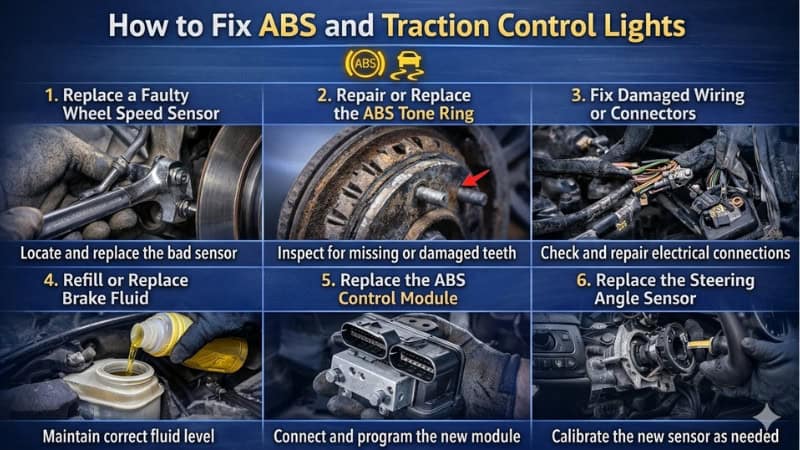
1. Replace a Faulty Wheel Speed Sensor
A bad wheel speed sensor is the most frequent cause of ABS and traction control warning lights. If a sensor stops sending accurate data to the ABS module, the system cannot properly monitor wheel movement.
Replacing the faulty sensor is usually a straightforward repair. The sensor is typically located near the wheel hub or brake assembly, and once replaced, the warning lights will often disappear after clearing the error codes.
2. Repair or Replace the ABS Tone Ring
If the ABS tone ring (reluctor ring) is cracked, rusted, or missing teeth, the wheel speed sensor may receive incorrect readings.
In this case, the damaged tone ring must be cleaned or replaced. Sometimes the tone ring is part of the axle shaft or wheel bearing assembly, which may require replacing the entire component.
3. Fix Damaged Wiring or Connectors
Electrical problems are another common cause of ABS faults. If the wiring connected to the sensors or ABS module becomes damaged, the system may lose communication with the sensors.
Repairing the wiring may involve:
- Reconnecting loose connectors
- Repairing broken wires
- Cleaning corroded electrical terminals.
Once the wiring issue is resolved, the ABS system can resume normal operation.
4. Refill or Replace Brake Fluid
If the brake fluid level is low, refilling the reservoir may resolve the warning lights. However, it is important to determine why the fluid level dropped in the first place.
Possible causes include:
- Brake fluid leaks
- Worn brake pads
- Air in the brake system
A proper brake system inspection is recommended before simply adding fluid.
5. Replace the ABS Control Module
If the ABS control module fails internally, the entire unit may need to be replaced or reprogrammed. This repair is more expensive than replacing sensors, but it is sometimes necessary when the module stops processing signals correctly.
After installing a new module, the system must usually be reprogrammed and calibrated using a diagnostic scanner.
6. Replace the Steering Angle Sensor
If the steering angle sensor fails or loses calibration, the traction control and stability control systems may stop functioning.
Replacing the sensor and performing a steering angle calibration with a scan tool can restore normal system operation and turn off the warning lights.
In most cases, once the faulty component is repaired and the ABS codes are cleared with a diagnostic scanner, the ABS and traction control lights will turn off, and the systems will return to normal operation.
Cost to Fix ABS and Traction Control Light
The cost to fix ABS and traction control warning lights can vary depending on the exact problem and the type of vehicle. In many cases, the repair may be relatively inexpensive, such as replacing a faulty sensor. However, more complex issues, such as a failed ABS module, can be more costly.
Below are the typical repair costs drivers may expect.
| Wheel Speed Sensor Replacement | $100 – $300 |
| ABS Tone Ring Replacement | $150 – $400 |
| Brake Fluid Service | $80 – $150 |
| Steering Angle Sensor Replacement | $150 – $500 |
| Wiring Repair | $100 – $350 |
| ABS Control Module Replacement | $400 – $1,200 |
The wheel speed sensor is the most common and least expensive repair, while replacing the ABS module is the most expensive.
Keep in mind that labor costs can vary by vehicle model, location, and repair shop rates. Luxury and modern vehicles with advanced driver assistance systems may require additional calibration, which can increase repair costs.
Pro Tips Mechanics Use for ABS Light Diagnosis
Experienced mechanics follow a few important steps to diagnose ABS and traction control problems quickly and accurately.
Always scan ABS codes first.
Before replacing any parts, mechanics use a diagnostic scanner to read the ABS fault codes. This helps pinpoint the exact component causing the issue.
Inspect sensors before replacing them.
Wheel speed sensors can sometimes become dirty from road debris or brake dust. Cleaning the sensor may solve the problem without needing replacement.
Check wheel bearings
A worn or loose wheel bearing can affect the signal from the wheel speed sensor, triggering ABS warning lights.
Inspect wiring near the wheels.
The wiring around the wheel hubs is exposed to water, dirt, and road debris. Damaged wires are a common cause of ABS lights.
Clear codes after repairs
After fixing the problem, mechanics clear the diagnostic codes using a scanner and test drive the vehicle to confirm the system is working correctly.
Frequently Asked Questions(FAQs)
Why do ABS and traction control lights come on after starting the car?
This usually happens when the vehicle’s computer detects a problem with a wheel speed sensor, ABS module, or electrical connection. The system disables both safety features until the issue is repaired.
Can a bad wheel bearing cause the ABS light to come on?
Yes. A worn wheel bearing can affect the wheel speed sensor signal, potentially triggering both the ABS and traction control lights.
Will disconnecting the battery reset the ABS light?
Disconnecting the battery may temporarily clear the warning lights, but the lights will return if the underlying problem is not fixed.
Can low tire pressure trigger traction control lights?
In some vehicles, extremely low tire pressure can affect wheel speed readings and trigger traction control warnings.
Final Thoughts
When the ABS and traction control lights come on together, it usually means a problem with a component shared by both systems. The most common causes include a faulty wheel speed sensor, a damaged tone ring, wiring problems, or a failing ABS module.
Although the vehicle may still be drivable, these warning lights indicate that important safety systems are not functioning properly. Diagnosing the issue with a scan tool and proper inspection is the best way to identify the exact cause.
Repairing the problem quickly will restore your vehicle’s braking stability and traction control, helping ensure safer driving in all road conditions.
