
If you want to find the exact replacement parts for your vehicle, using the VIN (Vehicle Identification Number) is one of the most accurate methods available. The VIN is a unique 17-character code assigned to every vehicle, and it contains detailed information about the car’s manufacturer, engine type, model year, transmission, trim level, and production details. Because every vehicle has a unique VIN, parts databases can identify the exact specifications of the car. This means you can easily find car parts by VIN number, whether you’re searching in the USA or Europe, and even for specific brands like Toyota.
When you enter the VIN into a VIN decoder or auto parts lookup system, the system reads the vehicle data and displays compatible parts for that specific vehicle. This helps eliminate guesswork when searching for replacement components such as brake parts, sensors, filters, engine components, or suspension parts. Many auto parts websites and dealership databases use VIN lookup to ensure customers get the correct parts the first time. In fact, many platforms let you find OEM part numbers by VIN for free, making it easier to order the right components online.
VIN-based parts lookup saves time, money, and hassle. Unlike relying on make, model, and year—which often yields multiple variants—the VIN guarantees an exact match. For car owners and mechanics, using the VIN is a reliable way to avoid incorrect orders and ensure perfect fitment. If you want a free VIN-based parts lookup, many online services offer it.
What Is a VIN Number?
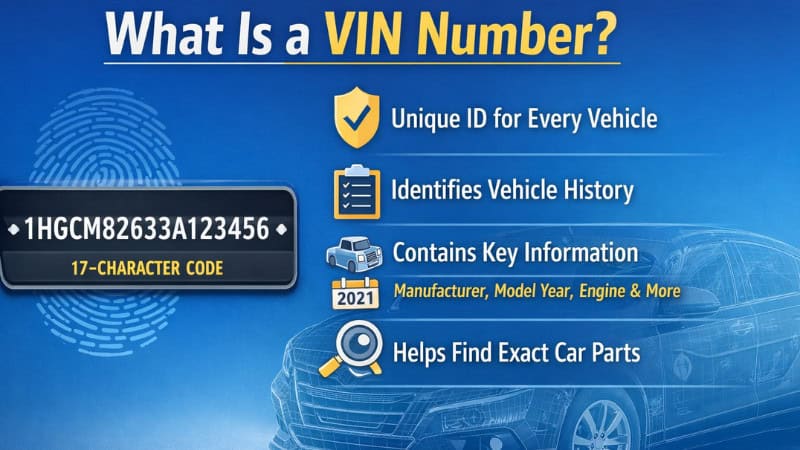
The VIN (Vehicle Identification Number) is a unique 17-character code assigned to every vehicle by the manufacturer. It works like a fingerprint for your car, meaning no two vehicles have the same VIN. This number is used worldwide to identify a vehicle’s specifications, manufacturing details, and other details.
Every vehicle’s unique VIN allows accurate identification by manufacturers, dealerships, mechanics, and insurance companies. It is used for vehicle registration, warranty claims, recall tracking, accident history, and parts identification. Unique VINs help prevent confusion between similar vehicles with different engines, trims, or configurations.
The VIN contains important information about the vehicle, including the manufacturer, country of origin, model year, engine type, body style, transmission, and production plant. By decoding the VIN, mechanics and parts suppliers can quickly identify the vehicle’s exact specifications, making it much easier to find the correct replacement parts and avoid compatibility issues during repairs.
Where to Find the VIN Number on Your Car
The VIN number is located in several places on a vehicle to make it easy to identify for registration, inspections, repairs, and parts lookup. If you need the VIN to find the correct replacement parts, there are a few common places to quickly locate it on your car.
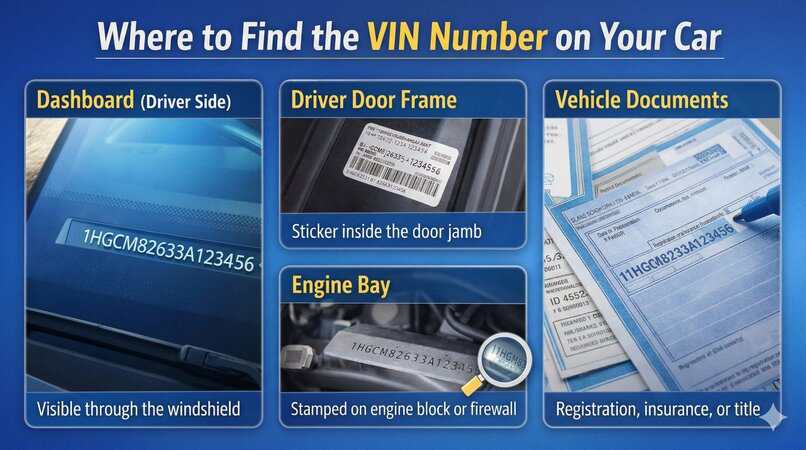
Dashboard (Driver Side)
One of the most common places to find the VIN is on the driver’s side dashboard. It is usually located near the base of the windshield. You can see it from outside the vehicle by looking through the windshield on the driver’s side. This location makes it easy for law enforcement, mechanics, and inspectors to quickly identify the vehicle.
Driver Door Frame
Another common location is inside the driver’s door frame. Upon opening the door, you’ll see a VIN sticker or metal plate on the door jamb. This often also lists build date, weight ratings, and tire info.
Engine Bay
In some vehicles, the VIN is also stamped in the engine bay, usually on the firewall or the engine block. This stamped VIN is used for verification purposes and helps confirm the vehicle’s identity, especially during inspections or when major engine components are replaced.
Vehicle Documents
The VIN appears on vehicle registration, insurance, title certificates, and service records. If it’s hard to see on your car, quickly locate it in these documents.
Why Using VIN for Car Parts Lookup Is Important
Using the VIN number to search for car parts is one of the most reliable ways to ensure you get the correct replacement components for your vehicle. Many cars may look identical on the outside but have different engines, transmissions, trims, or production variations. By using the VIN, parts databases can accurately identify your vehicle’s exact specifications, helping you avoid mistakes when ordering parts.
One of the biggest advantages of VIN-based parts lookup is that it prevents purchasing the wrong parts. When you search only by make, model, and year, there can be multiple variations of the same vehicle. The VIN helps identify the exact engine type, transmission, drivetrain, and trim level, ensuring the replacement part matches your vehicle perfectly.
Using the VIN also saves money and time on repairs. Ordering the wrong part can delay repairs and lead to additional costs for returns or replacements. Since modern vehicles often offer multiple engine options, electronic systems, and trim packages, VIN lookup helps ensure compatibility and speeds up repairs for both DIY car owners and professional mechanics.
How to Find Car Parts with VIN Number Online (Step-by-Step)
Finding the correct car parts using a VIN number is a simple process when you follow the right steps. Since the VIN contains detailed information about your vehicle, it enables parts databases to identify components specifically designed for your car. Below is a step-by-step guide to help you quickly and accurately find the correct replacement parts.
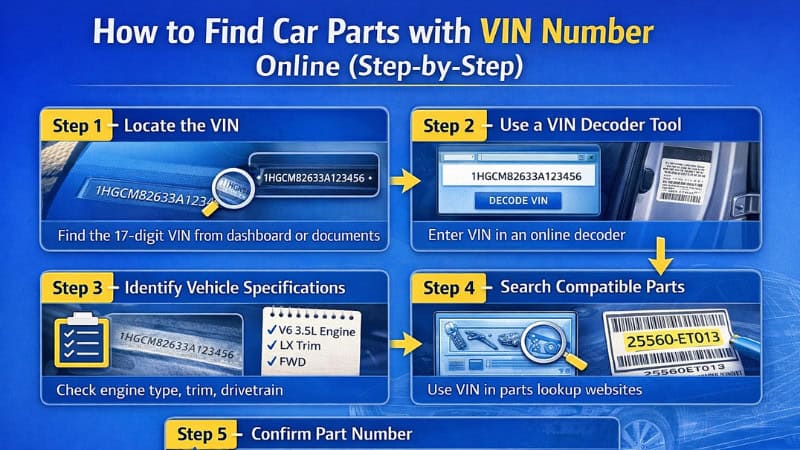
Step 1 – Locate the VIN
The first step is to find your vehicle’s 17-digit VIN number. You can usually locate it on the driver’s side dashboard near the windshield, inside the driver’s door frame, or on official documents such as the vehicle registration, insurance papers, or title certificate. Make sure to copy the VIN carefully, as even a single incorrect character can result in incorrect vehicle information.
Step 2 – Use a VIN Decoder Tool or OEM Part Number Search
Once you have the VIN, enter it into a VIN decoder or online vehicle lookup tool. These tools read the VIN and provide detailed vehicle information, including the manufacturer, model year, engine type, trim level, and production information. Many automotive websites and dealership databases provide free VIN decoding services. You can also use an OEM part number search by VIN to find specific parts for your car with precision.
Step 3 – Identify Vehicle Specifications
After decoding, review provided specs: engine size, transmission, drivetrain (FWD, AWD, RWD), trim, body style. These details are vital—multiple variations exist, and accurate specs ensure compatible parts.
Step 4 – Search Compatible Parts
Next, input the VIN into auto parts search engines or dealer catalogs. VIN entry yields parts tailored to your vehicle. This approach is far more precise than using make, model, and year. Whether in the USA or Europe, reliable databases make VIN lookups easy.
Step 5 – Confirm Part Number
Before ordering, verify the OEM (Original Equipment Manufacturer) part number. An exact match ensures correct fit and function. You can often obtain OEM part numbers by VIN for free on online platforms. Professional mechanics always confirm OEM numbers to avoid issues.
Best Websites to Find Car Parts Using VIN
Several online platforms let you search for car parts by VIN, making it easier to find the exact components that match your vehicle. These websites use VIN-based databases to identify your vehicle’s specifications and recommend compatible parts. Below are some of the most popular and reliable platforms mechanics and DIY car owners use.
AutoZone
AutoZone is one of the most popular auto parts retailers in the United States. Their website lets you enter your VIN or vehicle details to identify compatible parts for your car. Once the VIN is entered, AutoZone filters the results to show parts that match your vehicle’s engine type, model year, and trim level, helping reduce the chances of ordering the wrong component.
RockAuto
RockAuto is widely used by professional mechanics because it offers a large catalog of OEM and aftermarket parts at competitive prices. While RockAuto mainly uses vehicle details like make, model, and engine type, you can first use a VIN decoder to match the specifications and find the correct parts. The site also provides detailed part categories and manufacturer options.
PartsGeek
PartsGeek is a trusted marketplace for OEM and aftermarket parts. Enter your VIN or vehicle info to filter your search. Detailed product descriptions and compatibility details help ensure correct selection.
CarParts.com
CarParts.com offers a user-friendly parts search system that lets you enter your VIN or vehicle information to find compatible replacement parts. The platform provides detailed fitment information, so you can verify that the part will fit your car before purchasing. This makes it a convenient option for both beginners and experienced DIY mechanics.
Dealer Parts Websites
Many official dealership parts websites also allow VIN-based parts lookup. When you enter your VIN, the system pulls data directly from the manufacturer’s database and shows the exact OEM parts designed for your vehicle. This method is often the most accurate way to find factory-original components, although dealership parts may sometimes be more expensive than aftermarket alternatives.
Common Car Parts You Can Identify with VIN
Using the VIN number, you can identify many different components designed specifically for your vehicle. Because the VIN reveals important details such as the engine type, transmission configuration, trim level, and production year, parts databases can match your vehicle with compatible replacement components. This is especially useful for modern vehicles, which often have multiple variants of the same model.
Engine Components
Many engine parts can be accurately identified using the VIN. These include components such as spark plugs, ignition coils, fuel injectors, timing components, gaskets, and engine sensors. Since engines can vary by trim and production year, VIN lookup helps ensure you get the exact parts that match your engine configuration.
Transmission Parts
The VIN can also help identify the correct transmission components for your vehicle. This includes transmission filters, solenoids, clutch components, torque converters, and transmission control modules. Because vehicles may come with either manual or automatic transmissions, using the VIN helps prevent ordering incompatible parts.
Brake Components
Brake systems often vary depending on the vehicle’s trim level, drivetrain, or brake package. With a VIN lookup, you can find the correct brake pads, rotors, calipers, master cylinders, and ABS components for your specific vehicle model.
Suspension Parts
Suspension components such as control arms, shocks, struts, sway bar links, and bushings can also be identified using the VIN. This is important because suspension setups may vary by vehicle trim level, performance package, or drivetrain configuration.
Sensors and Electronic Modules
Modern vehicles rely heavily on electronic sensors and control modules, and these parts must match the vehicle’s system exactly. VIN lookup helps identify compatible components such as oxygen sensors, crankshaft sensors, camshaft sensors, ABS sensors, ECU modules, and VVT solenoids, ensuring proper fitment and performance.
VIN vs Manual Parts Search
When searching for replacement car parts, you can either use the VIN number or manually search by the vehicle’s make, model, and year. While manual searches may work in some cases, VIN-based searches are usually much more accurate because they use detailed vehicle data directly from the manufacturer. This is especially important for modern vehicles that have multiple trims, engine options, and drivetrain variations.
| More accurate results | Higher risk of ordering the wrong part |
| Uses detailed vehicle data | Based only on make, model, and year |
| Identifies the exact engine and trim | May miss important vehicle variations |
| Works well with modern vehicles | Difficult when vehicles have multiple trims |
Using the VIN lookup method helps ensure you get parts designed specifically for your vehicle, reducing the chances of compatibility issues during installation. This is especially useful if you need to find car parts by VIN for a Toyota or any other specific brand.
Common Mistakes When Searching for Car Parts
Even when using a VIN number, people sometimes make mistakes that can lead to ordering the wrong parts. Understanding these common errors can help you avoid delays and unnecessary expenses during repairs.
Using the Wrong VIN Digit
The VIN contains 17 characters, including both numbers and letters. Entering even a single incorrect character can lead to incorrect vehicle information or parts results. Always double-check the VIN before using it in a parts lookup system.
Ignoring Trim Level
Many vehicles come with multiple trim levels and engine options, which can affect the type of parts required. If the trim level or engine specification is not verified, you may end up selecting parts that do not fit your vehicle.
Buying Parts Without Checking the OEM Number
Professional mechanics often verify the OEM (Original Equipment Manufacturer) part number before ordering. Matching the OEM number ensures the replacement part is designed specifically for your vehicle.
Using Generic Parts Search
Searching only by make, model, and year, without verifying VIN details, can sometimes result in an incorrect part selection. VIN-based searches provide more precise results and reduce the chances of compatibility issues.
Pro Tips Mechanics Use for VIN Parts Lookup
Professional mechanics rely on several best practices when using the VIN number to find car parts. These tips help ensure the replacement parts match the vehicle perfectly and prevent installation problems during repairs.
Always Double-Check the OEM Part Number
Before purchasing any part, experienced mechanics always verify the OEM (Original Equipment Manufacturer) part number. Even if a VIN search suggests compatible parts, confirming the OEM number ensures the component is exactly what the vehicle manufacturer recommends.
Use Dealership Databases
Many mechanics use dealer parts catalogs or manufacturer databases because they provide the most accurate VIN-based information. These systems pull data directly from the automaker and display the exact factory parts designed for the vehicle.
Verify the Engine Code
Some vehicles have multiple engine options within the same model year. Mechanics often check the engine code or specification after decoding the VIN to ensure replacement parts match the correct engine configuration.
Compare Parts Photos
Another useful technique is to compare the part photos with the original component on the vehicle. Looking at connectors, mounting points, and overall design can help confirm that the part will fit correctly before placing an order.
Final Thoughts
Using the VIN number to find car parts is one of the safest and most accurate ways to ensure compatibility. Because the VIN contains detailed information about your vehicle’s specifications, it allows parts lookup systems to identify the exact components designed for that car. This reduces guesswork and prevents costly mistakes when ordering replacement parts.
Whether you are a DIY car owner or a professional mechanic, VIN lookup tools make the parts search process faster and more reliable. By verifying the VIN, checking OEM part numbers, and confirming vehicle specifications, you can confidently purchase the correct parts and complete repairs without unnecessary delays.
