
Electric vehicles feature advanced electronics and specialized control modules, requiring diagnostic tools that go beyond standard OBD2 scanners. Basic scanners often miss critical data from EV components, making it essential for both professional and DIY users to choose the right tool for electric-vehicle diagnostics.
A high-quality EV-compatible OBD2 scanner can access critical systems, including the battery management system (BMS), charging system, regenerative braking, and electric motor controls. These advanced scanners allow you to monitor live data, including battery temperature, state of charge (SOC), state of health (SOH), and charging performance, helping you identify issues before they become serious problems. This level of diagnostics is essential for modern EVs like the Tesla Model 3, Nissan Leaf, Chevy Bolt, and Hyundai Kona Electric.
This guide reviews the best OBD2 scanners for electric vehicles, highlights must-have features, and compares reliable tools. The right scanner helps diagnose electric vehicles more efficiently and accurately, whether for professional or home garage use.
Next, let’s address a common question: Can you use a regular OBD2 scanner on an electric vehicle?
Electric vehicles have OBD2 ports like gasoline cars, so basic scanners can connect and read some data. However, EVs rely on complex electronic systems. Regular OBD2 scanners may read simple trouble codes, but usually cannot access deeper diagnostic information, which is crucial for assessing EV performance and battery health.
How EV Diagnostics Work
Electric vehicles use standard OBD-II protocols, enabling diagnostic tools to connect and retrieve data. However, EVs have additional control modules that manage battery packs, charging, thermal systems, and motors, making diagnosis more complex than in traditional vehicles.
Many inexpensive OBD2 scanners are designed for gasoline vehicles and only read generic diagnostic trouble codes (DTCs). These scanners usually access only the engine control module or a limited number of systems. Because EVs don’t have a traditional engine, most of their important diagnostic systems remain hidden from basic scanners.
Limitations of Basic OBD2 Scanners
Basic OBD2 scanners have several limitations when diagnosing electric vehicles. One major limitation is that they cannot access the battery management system (BMS), which monitors battery health, voltage balance, and charging performance. Without access to this system, diagnosing battery problems becomes extremely difficult.
Cheap scanners often fail to access motor controller faults or inverter systems, both critical components in EV powertrains. They also provide limited access to EV-specific modules, such as regenerative braking systems, onboard chargers, and thermal management systems that regulate battery temperature.
Why EV-Compatible Scanners Are Different
OBD2 scanners designed for electric vehicles communicate with advanced EV control modules that standard scanners cannot reach. These tools access battery management systems, charging controllers, electric drive units, and other specialized modules used in modern EV platforms.
These scanners also let you monitor live EV data, including battery temperature, voltage levels, state of charge, and energy usage. Many advanced scanners include battery diagnostic tools that help technicians evaluate battery health and detect early signs of degradation. Anyone working with electric vehicles can achieve far more accurate and efficient diagnostics with an EV-compatible scanner.
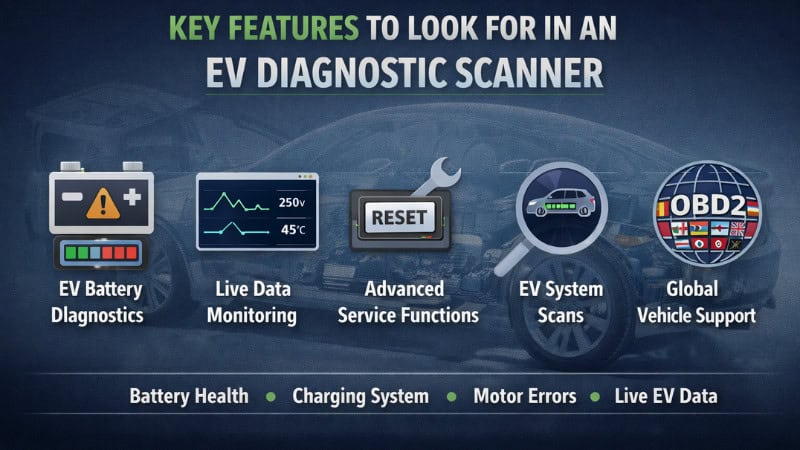
Key Features to Look for in an EV Diagnostic Scanner
Electric vehicles rely on complex electronics, battery systems, and multiple control modules, which require more advanced diagnostic capabilities than those of traditional gasoline vehicles. When choosing the best OBD2 scanner for diagnosing electric vehicles, it’s important to look for features that allow deep access to EV-specific systems. A good EV diagnostic scanner should provide detailed battery data, high-voltage system diagnostics, and real-time monitoring to help detect problems quickly and accurately.
Battery Health Monitoring
One of the most important features in an EV diagnostic scanner is its ability to monitor battery health. Because the battery pack stands as the most expensive component in an electric vehicle, diagnosing its condition remains critical for maintenance and troubleshooting.
Most advanced scanners provide important battery data such as State of Charge (SOC), which shows how much energy the battery currently stores, and State of Health (SOH), which indicates the battery’s overall condition and remaining capacity compared to when it was new. Monitoring these values helps mechanics and vehicle owners understand battery performance and spot early signs of degradation.
High Voltage System Diagnostics
Electric vehicles operate using high-voltage electrical systems, and diagnosing issues in these systems requires specialized diagnostic tools. A high-quality EV scanner can detect battery-pack faults, identify battery-cell issues, and help locate voltage imbalances or charging errors.
These scanners can also detect inverter issues, which affect how power flows from the battery to the electric motor. In addition, they can read faults from the motor controller, which controls the electric drive system. Access to these systems allows technicians to diagnose EV drivetrain problems much more efficiently.
Live Data Monitoring
Another essential feature is live data monitoring, which allows technicians to view real-time information from the vehicle while it is operating. This access helps identify performance issues that may not be detected by a simple fault code scan.
For example, EV diagnostic scanners display battery temperature, a critical factor for maintaining battery safety and performance. They can also display charging status, allowing users to monitor how the vehicle charges and detect charging system faults. Some scanners provide energy consumption data, helping you analyze vehicle power efficiency.
Manufacturer-Specific Code Reading
Electric vehicles from different manufacturers often use their own proprietary diagnostic codes and modules. A basic scanner may only read generic codes, whereas an advanced EV scanner accesses manufacturer-specific systems and retrieves more detailed diagnostic information.
For example, some scanners support detailed diagnostics for vehicles such as Tesla, Nissan Leaf, Chevy Bolt, and Hyundai Kona Electric. With access to these manufacturer-specific codes, technicians can diagnose issues more accurately and avoid unnecessary repairs.
Wireless Connectivity
Modern EV diagnostic scanners often feature wireless connectivity, making them easier and more convenient to use. Many scanners connect to smartphones or tablets via Bluetooth, allowing users to run diagnostics through mobile apps.
Some advanced models also support Wi-Fi connectivity, which enables faster data transfer and easier software updates. Wireless scanners are especially useful for mechanics and DIY users because they offer a portable, user-friendly way to diagnose electric vehicles without a dedicated diagnostic computer.
7 Best OBD2 Scanners for Diagnosing Electric Vehicles
Modern electric vehicles require advanced diagnostic tools that read battery data, detect high-voltage system faults, and uncover manufacturer-specific trouble codes. The scanners below offer some of the best OBD2 tools for diagnosing electric vehicles, delivering reliable EV compatibility, live data monitoring, and deep system access for professional mechanics and DIY users alike.
1. Autel MaxiCOM MK808: Best for Professional EV Diagnostics

The Autel MaxiCOM MK808 is one of the most trusted professional diagnostic scanners available today. It supports a wide range of vehicles, including many modern EVs and hybrids, and provides full system diagnostics with advanced features. The MK808 allows technicians to access critical modules, including the battery management system, inverter systems, charging modules, and electric drivetrain components.
Its large touchscreen interface and fast processor make scanning vehicles and reading live data quick and easy. The scanner also supports service functions, including EPB reset, oil reset, SAS calibration, and battery registration, making it a powerful tool for both electric and gasoline vehicles.
Pros
- Full system diagnostics for many EV and hybrid vehicles
- Large touchscreen tablet interface
- Fast scanning and live data monitoring
- Supports multiple service reset functions
- Regular software updates from Autel
- Wide vehicle compatibility
Cons
- Higher price compared to entry-level scanners
- Some EV brands require additional updates.
2. Launch X431 V+: Best Bidirectional EV Diagnostic Tool

The Launch X431 V+ stands as a powerful professional diagnostic scanner renowned for its bidirectional control capabilities. This tool not only reads data but also sends commands to vehicle systems, so technicians can perform active tests on various components.
For electric vehicles, the X431 V+ can access key modules, including battery systems, inverter controls, charging systems, and motor controllers. It also supports advanced coding and programming features that are often required when replacing EV components. With its tablet-style design and large vehicle database, it is widely used in professional repair shops worldwide.
Pros
- Advanced bidirectional diagnostic control
- Deep system access, including EV modules
- Large vehicle coverage worldwide
- Fast tablet-based interface
- Supports ECU coding and programming
- Regular software updates
Cons
- Expensive for DIY users
- Learning curve for beginners
3. Foxwell NT809: Affordable EV Diagnostic Scanner

The Foxwell NT809 is a great choice for mechanics looking for a reliable scanner without spending a fortune. It provides full system diagnostics and supports many EV and hybrid systems, making it a good mid-range tool for smaller garages or serious DIY users.
The NT809 offers a simple touchscreen interface and can read trouble codes from systems like battery management modules, charging systems, and vehicle electronics. It also provides live data streams that enable users to monitor system performance in real time. For its price, the NT809 delivers solid diagnostic capabilities and broad vehicle compatibility.
Pros
- Affordable compared to professional scanners
- Full system diagnostics
- Easy-to-use touchscreen interface
- Live data monitoring support
- Good vehicle coverage
- Compact and portable design
Cons
- Limited advanced programming features
- Smaller vehicle database than premium scanners
4. Autel MaxiAP AP200: Best Budget Bluetooth EV Scanner

The Autel MaxiAP AP200 is a compact Bluetooth diagnostic scanner that connects directly to a smartphone or tablet. Despite its small size, it provides impressive diagnostic capabilities for the price and works well for many electric and hybrid vehicles.
Using the Autel mobile app, users can scan vehicle systems, read diagnostic codes, and monitor live data from EV modules. It’s especially useful for DIY car owners looking for a portable, affordable diagnostic tool. Because it works through a smartphone interface, it’s extremely easy to use and update.
Pros
- Very affordable EV diagnostic option
- Bluetooth connectivity with smartphone apps
- Compact and portable design
- Good live data monitoring
- Easy software updates
- Ideal for DIY mechanics
Cons
- Limited advanced diagnostics compared to Pro Tools
- Requires a smartphone to operate
5. BlueDriver Bluetooth Pro: Best Mobile-App EV Scanner

The BlueDriver Bluetooth Pro is one of the most popular mobile-based OBD2 scanners available today. It connects to a smartphone via Bluetooth and uses the BlueDriver app to run diagnostics and display live vehicle data.
While it is primarily used to diagnose gasoline vehicles, it also works with many EV and hybrid systems, depending on the vehicle model. The app provides repair reports, live data graphs, and manufacturer-specific codes, making it very helpful for diagnosing common vehicle problems.
Pros
- Easy smartphone app interface
- Wireless Bluetooth connection
- Reliable diagnostic reports
- Live data monitoring with graphs
- No subscription fees
- Great for DIY car owners
Cons
- Limited advanced EV diagnostics
- Not ideal for professional repair shops
6. Thinkcar ThinkTool Mini: Professional EV and Hybrid Diagnostics

The Thinkcar ThinkTool Mini is a professional-level diagnostic tool designed for mechanics who need deep system access for modern vehicles, including electric and hybrid platforms. It offers full system scanning, live data monitoring, and advanced diagnostic functions.
This scanner can access critical EV modules, including battery management systems, charging control modules, and motor drive systems. It also supports service functions and system resets required when repairing modern vehicles. With its powerful software and reliable hardware, it is becoming increasingly popular among professional technicians.
Pros
- Professional EV and hybrid diagnostics
- Full system scanning capability
- High-speed processing performance
- Large touchscreen display
- Supports multiple service functions
- Regular software updates
Cons
- Higher cost than entry-level scanners
- Some features require additional subscriptions.
7. Innova 5610: Best Scanner for Beginners Diagnosing EVs

The Innova 5610 is a beginner-friendly diagnostic scanner designed for vehicle owners who want an easy way to diagnose car problems at home. It supports both handheld scanning and Bluetooth connectivity with the Innova mobile app.
While it doesn’t provide the deep diagnostics of professional tools, it can still read basic EV and hybrid system codes, display live data, and provide helpful repair suggestions. Its user-friendly interface makes it ideal for car owners who want to understand vehicle problems without complicated diagnostic software.
Pros
- Very easy to use for beginners
- Bluetooth and handheld scanner combo
- Reads basic EV and hybrid codes
- Helpful repair information in the app
- Affordable price
- Portable design
Cons
- Limited advanced EV diagnostics
- Not designed for professional repair shops
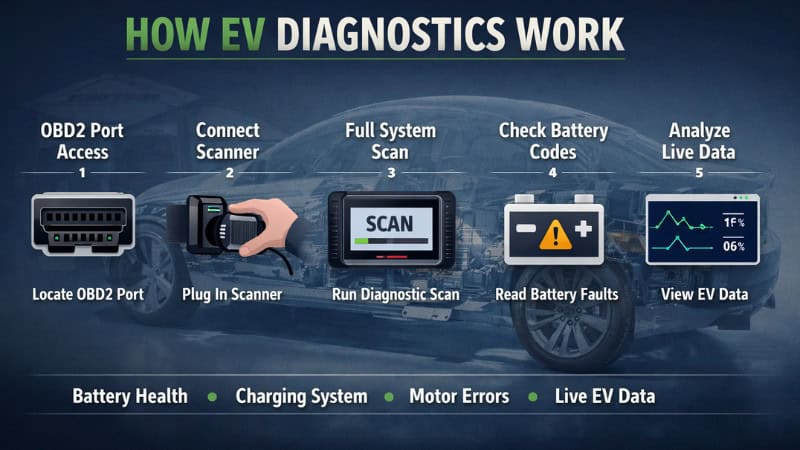
How to Diagnose Electric Vehicles Using an OBD2 Scanner
Diagnosing an electric vehicle is slightly different from working on a traditional gasoline car because EVs rely heavily on electronic control modules and battery management systems. A good EV-compatible OBD2 scanner allows you to read diagnostic trouble codes, monitor battery performance, and identify faults in systems such as the inverter, charging system, and electric motor. By following a few simple steps, mechanics and DIY car owners can quickly identify problems and understand what needs repair.
Step 1: Locate the OBD2 Port in the Vehicle
The first step is to locate the OBD2 diagnostic port in the vehicle. In most electric vehicles, the port is usually found under the dashboard on the driver’s side, near the steering column or behind a small plastic cover. This port allows the diagnostic scanner to communicate directly with the vehicle’s control modules.
Once you locate the port, make sure the vehicle is powered on or in accessory mode, as some scanners require the vehicle’s electronics to be active to connect.
Step 2: Connect the Scanner
Next, plug the OBD2 scanner connector into the vehicle’s diagnostic port. If you’re using a handheld scanner, it will power on automatically once connected. For Bluetooth or WiFi scanners, you may need to open the scanner’s mobile app and connect it to your phone or tablet.
After the connection is established, the scanner will begin communicating with the vehicle’s onboard computer systems. Most modern scanners will automatically detect the vehicle’s make, model, and year to start the diagnostic process.
Step 3: Run a Full System Scan
Once the scanner is connected, run a full system diagnostic scan. This process allows the scanner to check all available electronic control modules in the vehicle, including the battery management system, charging controller, braking system, and other electronic components.
A full scan helps identify any stored or pending trouble codes that may indicate system faults. These codes provide important clues about what system is experiencing issues and help guide further diagnostics.
Step 4: Check Battery System Codes
After completing the system scan, focus on battery-related diagnostic codes, since the battery pack is the most important component in an electric vehicle. The scanner may show faults related to battery voltage imbalance, charging system errors, or temperature management problems.
Many advanced scanners can access the Battery Management System (BMS), which monitors individual battery cells and overall battery performance. Reviewing these codes helps determine whether the issue is related to the battery pack, charging system, or another electrical component.
Step 5: Analyze Live EV Data
The final step is to analyze live data from the vehicle’s EV systems. Live data allows you to monitor real-time information such as battery temperature, charging voltage, current flow, and state of charge while the vehicle is operating.
By studying these values, technicians can detect abnormal behavior, such as overheating batteries, charging irregularities, or unusual power consumption. Live data analysis is often the key to diagnosing complex EV issues that may not trigger a simple trouble code.
Common EV Trouble Codes an OBD2 Scanner Can Detect
Electric vehicles rely on complex electronic systems to manage battery performance, motor operation, charging, and thermal control. When a problem occurs, the vehicle’s onboard computer stores diagnostic trouble codes (DTCs) that help identify the source of the issue. Using a quality OBD2 scanner for electric vehicles, technicians can retrieve these codes and quickly determine what system needs attention.
Although the exact codes may vary by manufacturer, many EVs generate similar categories of trouble codes related to the battery system, electric drivetrain, charging system, and cooling components. Reading these codes helps mechanics diagnose issues early before they lead to expensive repairs.
Battery Management System Faults
One of the most common problems detected in electric vehicles involves the Battery Management System (BMS). The BMS monitors battery voltage, temperature, and cell balance to ensure safe operation. If something goes wrong, the system will trigger trouble codes indicating problems such as voltage imbalance between battery cells, battery overheating, or reduced battery capacity.
These codes are critical because they help detect early battery degradation or potential battery-pack failures, which are among the most expensive repairs in an EV.
Charging System Errors
Electric vehicles also generate trouble codes related to the charging system. These codes can appear if there is a problem with the onboard charger, charging port, charging cable communication, or the high-voltage battery during charging.
For example, a vehicle may store codes when the battery fails to charge properly, when the charging system overheats, or when there is a communication failure between the charger and the battery pack. An OBD2 scanner helps technicians identify whether the issue is related to the charging hardware or the vehicle’s internal charging control module.
Motor Controller Failures
Another common type of EV diagnostic code involves the motor controller or inverter system, which controls how electricity flows from the battery to the electric motor. If there is a malfunction in the inverter or motor drive unit, the vehicle may display warning messages and store related fault codes.
These codes may indicate issues such as power delivery problems, inverter overheating, or motor control errors, which can affect vehicle acceleration and overall performance.
Cooling System Problems
Electric vehicles use specialized thermal management systems to regulate battery and motor temperatures. If the cooling system fails to operate correctly, the vehicle may generate diagnostic codes related to coolant pumps, temperature sensors, or cooling fans.
Maintaining proper battery temperature is extremely important for EV safety and performance. Trouble codes related to cooling systems help technicians quickly locate issues that could lead to battery overheating or reduced battery lifespan.
Regenerative Braking Faults
Many electric vehicles use regenerative braking systems to recover energy as they slow. This system converts kinetic energy into electrical energy and sends it back to the battery pack.
If the regenerative braking system malfunctions, the vehicle may store trouble codes indicating issues with braking sensors, regenerative control modules, or energy recovery systems. Diagnosing these codes helps ensure that the braking system operates safely and efficiently while maintaining optimal battery charging performance.
OBD2 Scanners Compatible With Popular Electric Vehicles
Most modern electric vehicles still include a standard OBD-II diagnostic interface, which allows scan tools to retrieve diagnostic trouble codes and live vehicle data from electronic control modules. However, the level of access depends on the vehicle manufacturer and the scanner’s capabilities. Advanced EV scanners can communicate with battery management systems, inverter modules, and charging systems to provide deeper diagnostics.
Below are some popular electric vehicles that are commonly supported by advanced OBD2 scanners.
Tesla Models
Tesla vehicles use highly advanced onboard electronics and proprietary systems. While they still have diagnostic communication networks, accessing deep system data often requires advanced scanners or Tesla-specific adapters.
Common Tesla models compatible with advanced diagnostic tools include:
- Tesla Model 3
- Tesla Model Y
- Tesla Model S
These vehicles feature complex battery management and electric drive systems that can be monitored with compatible diagnostic tools. In North America, Tesla models use the NACS charging connector for AC and DC charging, reflecting their unique hardware architecture.
Nissan
Nissan is one of the early pioneers of mass-market electric vehicles, and its EV systems are widely supported by modern diagnostic scanners.
Supported EV model:
- Nissan Leaf
The Nissan Leaf uses a well-documented battery management system and electronic modules, making it easier for many OBD2 scanners to access battery health data, charging system information, and motor controller diagnostics.
Chevrolet
Chevrolet has also developed widely used electric vehicles that support OBD2 diagnostics through compatible scanners.
Supported EV model:
- Chevy Bolt EV
The Bolt EV features advanced battery monitoring, regenerative braking systems, and electric drivetrain components that can be analyzed using professional OBD2 diagnostic tools.
Hyundai
Hyundai has expanded its EV lineup with several models that support modern diagnostic interfaces.
Supported EV models:
- Hyundai Kona Electric
- Hyundai Ioniq Electric
These vehicles use advanced battery management and charging systems that can be accessed through compatible diagnostic scanners, allowing technicians to read trouble codes, monitor battery health, and diagnose drivetrain issues.
OBD2 Scanner vs Professional EV Diagnostic Tools
Not all diagnostic tools offer the same level of access to electric vehicles. While a basic OBD2 scanner can read general trouble codes, more advanced diagnostic tools are required to access deeper EV systems such as the battery management system, inverter modules, and charging controllers. Professional mechanics often rely on advanced scanners or dealer-level diagnostic tools to perform complex diagnostics and programming tasks.
Understanding the differences between these tools helps mechanics and vehicle owners choose the right diagnostic equipment for their needs. Below is a simple comparison of the most common diagnostic tool types used for electric vehicles.
| Basic OBD2 Scanner | Reading basic error codes, clearing check engine lights, and monitoring limited live data |
| Advanced Scanner | Accessing EV battery diagnostics, reading manufacturer-specific codes, and viewing detailed live data |
| Dealer Tools | Deep system programming, ECU coding, software updates, and advanced EV system calibration |
A basic OBD2 scanner is suitable for simple diagnostics such as reading trouble codes and checking basic vehicle information. However, it usually cannot access deeper EV systems, such as battery modules or charging controllers.
An advanced scanner provides more powerful diagnostics, allowing technicians to monitor battery health, analyze live EV data, and diagnose faults in electric drivetrain components.
Finally, dealer-level diagnostic tools offer the most advanced capabilities. These tools are typically used by authorized service centers and allow full access to the vehicle’s electronic systems, including software programming, system calibration, and complex module replacements.
Safety Tips When Diagnosing Electric Vehicles
Electric vehicles use high-voltage electrical systems that differ significantly from those of traditional gasoline vehicles. While diagnosing EVs with an OBD2 scanner is generally safe, technicians and DIY mechanics should always follow proper safety procedures. The battery packs in electric vehicles can carry hundreds of volts, so taking the right precautions is essential to avoid injury and protect the vehicle’s electrical systems.
Avoid Touching High Voltage Components
Electric vehicles contain high-voltage components, including battery packs, orange high-voltage cables, inverters, and electric drive units. These parts carry a large amount of electrical energy and should never be touched unless the vehicle is properly powered down and handled by trained professionals. When diagnosing an EV, it is best to focus on reading diagnostic data through the OBD2 scanner rather than physically interacting with high-voltage components.
Use Insulated Tools
If any physical inspection or repair work is required, always use insulated tools designed for electrical systems. These tools help protect technicians from accidental electrical contact. Many professional EV technicians use specialized insulated gloves and tools rated for high-voltage environments when working around battery systems.
Always Disconnect Power When Required
Before performing certain maintenance or repair procedures, it may be necessary to disconnect the vehicle’s high-voltage battery system or follow a safe shutdown procedure. Many EV manufacturers provide specific steps for safely disabling the high-voltage system before repairs begin. Skipping this step can create serious safety risks.
Follow Manufacturer Procedures
Every electric vehicle manufacturer provides recommended service procedures and safety guidelines for diagnosing and repairing their vehicles. Always follow the manufacturer’s instructions when performing diagnostics or repairs. This ensures both technician safety and proper handling of sensitive EV components such as the battery management system and high-voltage circuits.
By following these safety tips, technicians and DIY mechanics can safely diagnose electric vehicles while minimizing risks associated with high-voltage electrical systems.
Final Thoughts
Electric vehicles rely on advanced electronics, battery systems, and multiple control modules, which require more capable diagnostic tools than those for traditional gasoline vehicles. While basic scanners may read simple error codes, diagnosing EV issues properly often requires a more advanced OBD2 scanner that can access battery management systems, charging modules, and electric drivetrain components.
Investing in the right EV-compatible OBD2 scanner allows mechanics and car owners to detect problems early, whether it’s a battery health issue, a charging fault, or a motor controller malfunction. Tools that support live data monitoring, manufacturer-specific codes, and full system scans make troubleshooting modern electric vehicles much faster and more accurate.
Whether you’re a DIY garage mechanic or a professional technician, having a reliable EV diagnostic scanner is becoming essential as electric vehicles continue to grow in popularity. With the right diagnostic tool, you can quickly identify problems, reduce repair time, and keep modern electric vehicles running efficiently.
