
Fixing cars used to be simple, needing only basic tools and experience. Older cars didn’t have warning lights or electronics. Now, cars depend on sensors and computers, making even small repairs tricky if a sensor triggers warning lights or disables features. For example, a loose gas cap might trigger the check engine light, confusing drivers and leading to unnecessary trips to the mechanic.
People often ask why modern cars have so many sensors. The main reasons are safety, emissions, and efficiency. Modern cars use many sensors to monitor engine airflow, wheel speed, steering, exhaust, and driver alertness. (Transforming Vehicle Architectures with Sensor Technologies, 2026)
Sensors make cars cleaner, safer, and more fuel-efficient, but also create new problems. Repairs can be more expensive and take longer to diagnose. A small issue can shut down key systems. Let’s explore why modern cars have so many sensors, the pros and cons, and what this means for U.S. drivers.
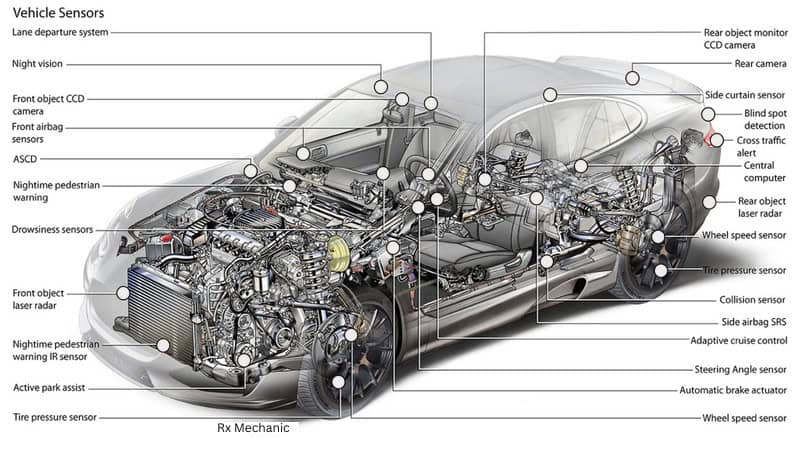
What Sensors Do in Modern Vehicles
In modern cars, sensors act like the car’s eyes, ears, and nerves. Instead of relying just on mechanical parts, today’s vehicles use sensors to keep track of what’s happening as you drive. Every second, many sensors send information to the car’s computer, called the ECU or PCM.
Each sensor has a basic job: measure something and send the correct information. This might be engine temperature, airflow, wheel speed, steering position, exhaust oxygen, or even whether a seatbelt is buckled. The computer uses this data to quickly decide things like how much fuel to use, when to shift gears, or how much brake pressure to apply.
For example, engine sensors help mix air and fuel so the engine runs clean and efficiently. Safety sensors check wheel speed and stability to help prevent skidding. Comfort sensors automatically handle climate control, lighting, and wiper speed, so you don’t have to adjust them yourself.
The downside is that modern cars rely more on sensors than on mechanical backups. If a sensor sends wrong or no information, the computer thinks something is wrong. That’s why one bad sensor can cause poor performance, warning lights, or even put the car in limp mode, even if the engine itself is fine.
In short, sensors don’t just help modern cars; they control them. This makes cars smarter, but also means they can have problems if even a small thing goes wrong.
Why Modern Cars Need So Many Sensors
Modern cars don’t have lots of sensors to seem high-tech. There are real reasons for it, mainly related to laws, safety, fuel economy, and what drivers expect. Here’s a closer look.
1. Emissions Regulations (Biggest Reason)
The main reason modern cars have so many sensors is to control emissions. Over time, the U.S. government, through the Environmental Protection Agency, has made emissions rules stricter to cut pollution and improve air quality.
To meet these strict rules, engines must run extremely clean and precisely. Sensors constantly monitor:
- Air enters the engine.
- Fuel delivery
- Exhaust gases leaving the tailpipe
Oxygen, airflow, and temperature sensors all work together to keep emissions within legal limits. If even one sensor sends wrong information, the computer can’t control emissions properly, so the check engine light comes on right away. That’s why emissions sensors are so important and why they sometimes fail.
2. Safety Systems
Today’s cars are much safer than older ones, largely because sensors are the foundation for all modern safety systems. For example, anti-lock braking systems (ABS), electronic stability control (ESC), and airbags all depend on sensors to receive accurate, real-time data. Sensors also track traction and stability to continually monitor the car’s condition during a drive.
3. Impact force and direction for airbags
Without sensors, features like anti-lock brakes, stability control, and advanced airbags wouldn’t work. Airbags need fast sensor readings to know when and how to deploy. One bad sensor can shut down an entire safety system, so it’s essential to heed safety warnings. Modern engines also adjust themselves in real time using feedback from these sensors to maintain performance and fuel efficiency.
Sensors help the computer:
- Fine-tune fuel injection
- Adjust ignition timing
- Respond instantly to driving.
This helps engines deliver more power while using less fuel. Modern cars get much better gas mileage than older ones, mainly because sensors keep the engine running smoothly. (Study: Fuel Efficiency Has Improved 35.4%, 2025) The downside is that if a sensor fails, fuel economy drops quickly, and the car may exhibit problems such as rough idling or poor acceleration.
4. Driver Convenience & Comfort
Besides engines and safety, sensors also make driving easier and more comfortable. Many features we now expect in cars wouldn’t be possible without sensors.
Standard comfort-related sensor systems include:
- Automatic climate control that adjusts cabin temperature
- Smart headlights that respond to lighting conditions
- Rain-sensing wipers that adjust speed automatically
- Automatic high beams and adaptive lighting
These features are a big reason why driving modern cars feels different. As cars become more automated, they rely on sensors even more.
Standard Sensors Found in Today’s Cars
Modern cars use many types of sensors to work correctly. Some help with engine performance, others with safety, and many are there to meet emissions and efficiency rules. Here are the most common sensors in today’s cars and what they do.
Oxygen Sensors (O2 Sensors)
Oxygen sensors monitor the amount of oxygen in the exhaust gases. This data helps the computer adjust the air-fuel mixture so the engine runs clean and efficiently. When an oxygen sensor fails, fuel economy drops, emissions increase, and the check engine light almost always comes on.
Mass Air Flow (MAF) Sensor
The MAF sensor measures the amount of air entering the engine. The computer uses this information to calculate how much fuel to inject. A dirty or bad MAF sensor can cause rough idling, hesitation, poor acceleration, and reduced MPG.
MAP (Manifold Absolute Pressure) Sensor
The MAP (Manifold Absolute Pressure) sensor measures engine load by reading intake manifold pressure. Engine load refers to how hard the engine is working at a given moment. The sensor helps the computer determine engine demand under different driving conditions. When this sensor fails, you may experience poor throttle response, stalling, or hard starts.
Wheel Speed Sensors
Wheel speed sensors monitor how fast each wheel is spinning. They are critical for ABS (Anti-lock Braking System), traction control, and stability control systems. A bad wheel speed sensor can disable ABS, traction control, and trigger multiple warning lights at once.
Camshaft & Crankshaft Position Sensors
These sensors track the exact position and rotation speed of the engine’s camshaft and crankshaft. The computer uses this data to control ignition timing and fuel injection. Failure can lead to misfires, no-start conditions, or sudden stalling.
TPMS (Tire Pressure Monitoring System) Sensors
TPMS sensors check the air pressure in each tire. If the pressure gets too low, a warning light comes on. These sensors aren’t needed for the engine to run, but they’re required by law in the U.S. and often fail when their batteries wear out. (Tire Pressure Monitoring System – Tire Industry Association, n.d.)
Steering Angle Sensor
The steering angle sensor measures the direction and rate of rotation of the steering wheel. It’s important for stability and lane-assist features. If it fails, you might see traction or stability warnings, even if the steering still feels fine.
Comparison Table: Old Cars vs Modern Cars
| Sensor Count | Very few (or none) | Dozens to hundreds |
| Engine Control | Mostly mechanical | Fully computer-controlled |
| Emissions Control | Minimal | Extremely strict |
| Safety Systems | Basic brakes | ABS, traction, stability control |
| Diagnostics | Visual inspection | Scanner-based diagnostics |
| Warning Lights | Rare | Very common |
| Repair Cost | Lower | Higher due to sensors |
| Drivability | Simple but less efficient | Smooth, efficient, data-driven |

The Pros of Having So Many Sensors
Sensors often get blamed for costly repairs and warning lights, but they play a big part in making modern cars safer, cleaner, and easier to drive. When everything works as it should, sensors actually make owning a car better.
Improved Safety
Modern safety systems rely entirely on sensor data. Sensors watch wheel speed, steering, movement, and impacts as you drive. This lets systems like ABS, traction control, stability control, and airbags respond immediately if something goes wrong.
Without sensors, features such as skid-prevention systems or quickly deployable airbags wouldn’t be possible. Sensors can even help prevent accidents before the driver realizes there’s a problem.
Cleaner Emissions
Sensors are the backbone of emissions control. By constantly monitoring air intake, fuel delivery, and exhaust gases, sensors help engines run cleaner than ever before. This reduces harmful emissions and keeps vehicles compliant with strict environmental standards.
Older cars ran richer and dirtier. Modern sensors allow engines to adjust and keep emissions low in almost all conditions.
Better Drivability
Thanks to sensors, modern cars start quickly, idle smoothly, and respond better to the gas pedal. Sensors let the computer adjust instantly for driving conditions, altitude, temperature, and engine load. This means fewer stalls or hesitation, which older cars often had.
Early Problem Detection
One significant advantage of sensors is their ability to provide early warning. They can spot problems before they become major failures. Often, a warning light comes on before any severe damage happens. This gives drivers a chance to fix minor issues early, potentially saving thousands in repair costs if the problem is addressed in time.
More Precise Engine Control
Modern engines are exact because sensors constantly send accurate data to the computer. Fuel injection, ignition timing, and emissions are adjusted down to the millisecond. This level of control improves power, fuel efficiency, and engine life. Compared to older cars, modern engines get more performance from smaller engines while using less fuel.
The Cons: Why Drivers Hate Sensor Problems
Sensors have many benefits, but they can also be a big headache for car owners. When a sensor fails, it can be confusing, expensive, and sometimes feels unnecessary, especially if the car still seems to run fine.
One Bad Sensor Can Shut Down the Whole System
In older cars, a single faulty part usually affected only one function. In modern vehicles, a single bad sensor can trigger a chain reaction. Because systems are interconnected, a single incorrect sensor reading can force the car into limp mode, disable safety features, or limit engine power.
The computer doesn’t take risks. If the data seems off, it assumes there’s a serious problem.
Constant Warning Lights
Modern dashboards are full of warning lights, and many of them are sensor-related. A bad sensor can trigger the check engine light, ABS light, traction control light, or even multiple warnings at once.
This can make drivers anxious, since it’s hard to tell if the problem is minor or something that could leave you stuck.
Expensive Diagnostics and Labor
Sensors themselves aren’t always expensive—but diagnosing them can be. Modern vehicles require scan tools, live data analysis, and sometimes advanced testing to confirm which sensor is actually bad.
Many drivers end up paying more for diagnostic time than for the sensor itself, especially when the issue isn’t apparent.
Sensors Fail More Often Than Mechanical Parts
Sensors work in harsh conditions like heat, vibration, moisture, oil, and road salt, which all wear them down. Unlike solid metal parts, sensors have electronic components that can degrade over time.
It’s common for engines to outlast the sensors that control them, which feels backward to many car owners.
False Codes and Misdiagnosis
A single bad sensor can cause another sensor to provide incorrect information. This often causes false error codes and leads to replacing parts that aren’t actually bad.
Without good diagnostics, drivers might replace several sensors before finding the real issue, wasting both time and money.
Higher Repair Costs Compared to Older Cars
Older cars were simpler and cheaper to fix. Modern sensor-heavy vehicles require specialized tools, training, and access to software. Even simple repairs can become expensive once sensors and recalibration are involved.
For many drivers, this is the biggest downside of modern automotive technology.
Are Modern Cars Over-Engineered?
Many drivers and mechanics agree that modern cars often feel over-engineered. It’s not that the technology is bad, but real-world driving conditions don’t always match the perfect situations these systems are designed for.
In theory, adding more sensors makes sense. Engineers want accurate data, better efficiency, and lower emissions. But in real life, cars deal with heat, cold, vibration, dirt, water, and road salt every day. Sensors have to work in places where even mechanical parts struggle.
Often, engines and transmissions are still strong, but the sensors that control them fail first. This means the computer says the car is “broken,” even when the main parts are delicate.
Another problem is the lack of backups. Older cars had mechanical ways to keep running if something failed. Modern cars depend on sensor data, so if that data is missing or wrong, the system shuts down to protect itself.
This doesn’t mean modern engineering is wrong. It just means today’s cars are built for precision, not for handling mistakes. They work well when everything is correct, but are less forgiving if something small goes wrong.
So, modern cars can seem over-engineered. But that complexity is the price for better safety, lower emissions, and higher efficiency.
Can You Drive With a Bad Sensor?
This is a common question when a warning light appears. The truth is, sometimes you can drive with a bad sensor, and sometimes you can’t. It depends on which sensor failed and how the car’s computer reacts.
When It’s Safe (Short-Term Only)
Some sensors mainly affect efficiency and emissions, not safety. If these fail, you can usually keep driving for a short while.
Examples include:
- A failed oxygen sensor
- A bad TPMS sensor
- A minor temperature or ambient air sensor issue
In these situations, the computer often uses backup settings to keep the car running. You might see worse gas mileage, rough idling, or a check engine light, but the car usually won’t stop right away.
Important: “Safe” does not mean “ignore it forever.” Driving long-term with a bad sensor can damage other components, including the catalytic converter or engine internals.
When It’s Dangerous
Some sensors are critical for safety or engine timing. If these fail, driving can be dangerous or leave you stranded.
Dangerous sensor failures include:
- Crankshaft position sensor
- Camshaft position sensor
- Wheel speed sensors (ABS-related)
- Steering angle sensor
- Throttle position–related sensors
These sensors help control ignition timing, braking systems, and vehicle stability. Failure can cause sudden stalling, loss of power, disabled ABS, or traction control shutdown. In these cases, driving should be avoided whenever possible.
Sensors That Should Never Be Ignored
Specific sensors are critical and should be addressed immediately:
- Crankshaft position sensor (can cause no-start or sudden stall)
- Wheel speed sensors (affect braking and stability)
- Airbag impact sensors (safety risk)
- Throttle and pedal position sensors (loss of throttle control)
Ignoring these sensors can make driving unsafe or cause your car to break down without warning.
How the ECU Reacts to Bad Data
The ECU, or engine control unit, is designed to protect your car. If it finds bad or missing sensor data, it responds in a few different ways:
- Turns on warning lights
- Switches to backup or “default” values
- Limits engine power (limp mode)
- Disables related systems, such as ABS or traction control.
- Shuts down the engine entirely in severe cases
The ECU doesn’t know if the sensor is wrong—it only knows the data doesn’t make sense. To prevent damage or accidents, it assumes the worst and restricts operation.
How to Reduce Sensor-Related Repair Costs
Sensor problems can be frustrating, but they don’t always have to be expensive. With the right steps, you can often manage or even avoid many sensor-related repairs.
Regular Maintenance Tips
Many sensors fail early due to neglect, not because they’re poorly made. Simple maintenance can make a big difference.
- Keep the engine air filter clean to protect the MAF sensor.
- Fix oil leaks quickly before they contaminate sensors.
- Replace spark plugs on time to prevent misfires that confuse sensors.
- Address warning lights early before problems spread.
Regular maintenance helps sensors work in cleaner, more stable conditions, so they last longer.
Using Quality Replacement Sensors
Not all sensors are created equal. Cheap aftermarket sensors often cause more problems than they solve.
Low-quality sensors may:
- Send inaccurate data
- Trigger false codes
- Fail prematurely
Whenever possible, use OEM or high-quality aftermarket sensors from trusted brands. They may cost more at first, but they usually save money by avoiding repeat repairs and wrong diagnoses.
Avoiding Unnecessary Parts Replacement
Guessing is one of the most significant ways to waste money on car repairs. A trouble code doesn’t always mean a sensor is bad; it just shows where the computer found a problem.
Many sensors are replaced unnecessarily when the real issue is:
- Wiring damage
- Corrosion in connectors
- Vacuum leaks
- Software or calibration problems
Changing parts without finding the real cause often wastes time and leads to more check engine lights.
Importance of Proper Diagnostics
Good diagnostics are key to keeping repair costs down. This means more than just scanning codes; it includes checking live data, testing circuits, and ensuring sensors work properly.
A skilled technician can determine whether:
- The sensor is actually faulty.
- The problem is mechanical, electrical, or software-related
- A repair or recalibration is needed instead of replacement.
Paying for accurate diagnostics upfront often saves far more than blindly replacing parts.
Will Future Cars Have Even More Sensors?
The short answer is yes: future cars will have even more sensors. As cars become more electric, automated, and software-driven, sensors are becoming even more critical.
EVs and ADAS Systems
Electric vehicles already rely heavily on sensors to manage battery temperature, charging speed, motor control, and energy efficiency. Unlike gas engines, EVs depend on precise electronic monitoring to protect expensive battery packs and power electronics.
On top of that, ADAS (Advanced Driver Assistance Systems) are rapidly becoming standard. Features like adaptive cruise control, lane-keeping assist, automatic emergency braking, and blind-spot monitoring all rely on constant sensor input. As ADAS evolves, sensor count and complexity increase dramatically.
Cameras, Radar, and LiDAR
Future vehicles won’t rely only on traditional sensors. They increasingly use:
- Cameras for lane detection and object recognition
- Radar for distance and speed measurement
- LiDAR for 3D mapping and depth perception
These systems help cars see what’s around them. While this makes driving safer, it also brings new challenges. After even minor repairs, like changing a windshield or fixing suspension, sensor alignment, calibration, and software compatibility become very important.
Software-Based Diagnostics Replacing Hardware
Another significant change is the move to software-based diagnostics. Instead of adding more physical sensors, car makers use advanced software to leverage better the data they already have.
This means:
- Fewer mechanical adjustments
- More over-the-air updates
- Increased reliance on vehicle software and subscriptions
In some cases, software can now detect problems before a physical sensor entirely fails, changing how diagnostics and maintenance work.
What This Means for Future Repairs
For drivers, future repairs will look very different:
- More calibration after repairs
- Higher diagnostic complexity
- Greater dependence on scan tools and software access
- Fewer DIY repair options for average owners
Repairs may shift from replacing parts to recalibrating systems and updating software. While vehicles will continue to get safer and more efficient, the cost and skill level required to repair them will likely keep rising.
FAQs
Why do modern cars have so many sensors?
Modern cars use many sensors to comply with strict emissions laws, improve safety, and enhance fuel efficiency. Sensors constantly monitor engine performance, exhaust gases, wheel speed, and vehicle stability. Without sensors, systems like ABS, traction control, airbags, and modern fuel management wouldn’t work. Today’s vehicles rely on real-time data rather than mechanical adjustments, which is why sensor counts have increased dramatically.
Which sensor fails the most?
Oxygen sensors and wheel speed sensors are among the most commonly failing sensors. Oxygen sensors fail due to heat and exhaust contamination, while wheel speed sensors are exposed to dirt, water, and road salt. MAF sensors and TPMS sensors also fail frequently, especially in high-mileage vehicles or cars that don’t receive regular maintenance. (Oxygen sensor, 2023)
Can a bad sensor damage the engine?
Yes, specific bad sensors can damage the engine if ignored. Sensors that control fuel mixture, ignition timing, or engine speed can cause the engine to run too rich or too lean. Over time, this can damage spark plugs, catalytic converters, or internal engine components. While some sensors only affect efficiency, others are critical to engine protection.
Why are sensors so expensive?
Sensors are expensive because they contain precision electronics and must meet strict accuracy standards. Many require calibration, software integration, and compatibility with the vehicle’s computer system. In addition, diagnostic labor adds to the cost since identifying the correct sensor often takes time and specialized tools—not just a simple code scan.
Do EVs have more sensors than gas cars?
Yes, electric vehicles generally have more sensors than gas-powered cars. EVs rely heavily on sensors to monitor battery temperature, charging systems, motor performance, and energy flow. Advanced driver assistance systems in EVs also add cameras, radar, and other sensors, increasing overall system complexity. (Electric Vehicle Sensor Market Size to Surge USD 60.20 Bn by 2034, 2025)
Can cheap sensors cause more problems?
Cheap sensors can absolutely cause more problems. Low-quality sensors may send inaccurate data, trigger false warning lights, or fail quickly. This often leads to repeat repairs, poor drivability, and misdiagnosis. Using OEM or high-quality aftermarket sensors usually costs more upfront but saves money and frustration in the long term.
Final Verdict: Are Too Many Sensors a Problem or Progress?
Modern cars don’t have lots of sensors by accident. They’re there because today’s cars are expected to be safer, cleaner, more efficient, and more innovative than ever. Sensors make this possible by helping prevent accidents, lowering emissions, improving fuel economy, and making driving smoother. In this way, sensors show progress.
But there is a real downside. More sensors mean more complexity, higher repair costs, and less room for minor mistakes. A car can be mechanically fine but still show warning lights or go into limp mode because of one bad sensor. This can be frustrating, especially for drivers used to older, simpler cars.
The truth is, modern cars are built for precision, not simplicity. Drivers can expect better performance and safety, but also more diagnostics, software, and sensor repairs. The best approach is regular maintenance, using quality parts, and getting accurate diagnostics. Sensors aren’t the enemy; they’re just the new normal.
