
Bypassing a Mass Air Flow (MAF) sensor—a device that measures air entering an engine—is often discussed among DIY mechanics troubleshooting rough idle, hesitation, or fuel trim issues. This forces the engine into speed-density backup mode, where it estimates airflow rather than measuring it. While it helps isolate airflow problems, it’s not a long-term fix. Modern engines need precise MAF data for fuel delivery, ignition timing, and emissions control. Substituting this data disrupts accurate engine management.
Before diving in, this guide explains why people attempt to bypass the MAF, the effects on engine performance, and the safest approach for troubleshooting. Understanding the MAF’s role is key, whether you’re diagnosing issues or tuning for performance.
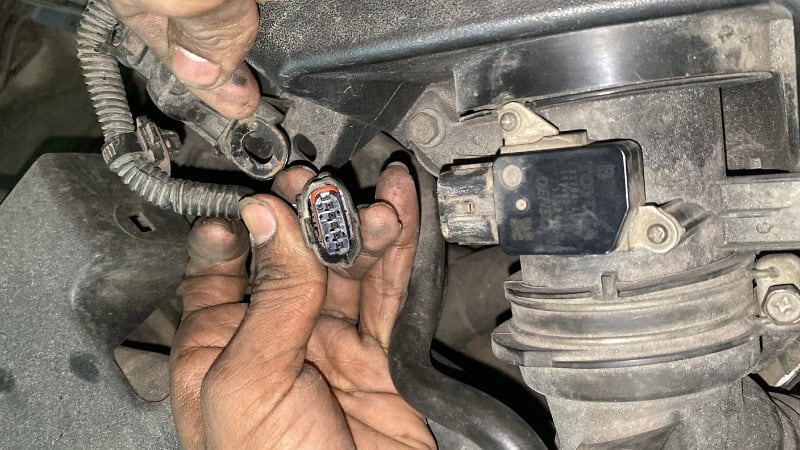
What a MAF Sensor Actually Does
The Mass Air Flow (MAF) sensor is essential on modern fuel-injected engines. Its main job is to measure precisely how much air is entering the engine so the powertrain control module (PCM)—the onboard computer that manages how the engine operates—can calculate how much fuel to add for efficient combustion. Additionally, the MAF reading helps the PCM adjust ignition timing (the precise moment the spark plug fires in each cylinder) and manage idle stability (keeping the engine running smoothly at low speed), ensuring the engine runs smoothly under all conditions.
Many MAF sensors use a hot-wire design, measuring the electrical current required to maintain a thin wire at a set temperature as air flows over it. When more air moves past the wire, more electrical current is needed to keep it hot. The sensor translates this change in current into a signal that the PCM can process as airflow data.
The MAF works together with other sensors. The Manifold Absolute Pressure (MAP) sensor measures air pressure in the intake manifold. The throttle position sensor (TPS) tracks the position of the gas pedal. The intake air temperature (IAT) sensor measures the temperature of the incoming air. O2 (oxygen) sensors measure oxygen levels in the exhaust gases. If any of these signals are off, the PCM cannot properly balance the air-fuel mixture.
If the MAF becomes inaccurate because of dirt, vacuum leaks, or electrical issues, the fuel system destabilizes. That leads to rough idle, hesitation, poor fuel economy, or black smoke—common moments when people try to bypass the MAF for diagnosis.
Why People Try to Bypass the MAF Sensor
Bypassing the MAF is a diagnostic step—not usually done casually. When an engine runs poorly, unplugging it helps identify if that’s the issue. Most vehicles switch to speed-density mode, making this helpful for troubleshooting, but it’s not a permanent solution.
1 Engine Runs Better With the MAF Unplugged
Many drivers notice that the engine idles smoothly or accelerates more smoothly with the MAF disconnected. That usually means the MAF is giving bad data, or that unmetered air is getting into the engine through a vacuum leak or a cracked intake boot.
2 Troubleshooting Fuel-Trim Issues
When fuel trims—automatic adjustments the engine’s computer makes to keep the air-fuel mixture balanced—are way off (with mixtures that are either too lean, meaning not enough fuel, or too rich, meaning too much fuel), a quick MAF bypass test helps determine whether the sensor is skewing airflow calculations.
3 Aftermarket Intakes Causing Problems
Cheap or poorly designed aftermarket air intakes often alter airflow patterns, confusing the MAF. Disconnecting it temporarily can help diagnose the issue.
4 Temporary Testing to Confirm a Faulty MAF
Bypassing lets mechanics compare how the engine behaves with and without the MAF to find issues.
5 Performance Tuning (Not Recommended for Street Cars)
Some tuners bypass the MAF to run custom fuel maps, but this is for controlled environments only—not for daily drivers.
Risks and Consequences of Bypassing a MAF Sensor
Bypassing the MAF helps diagnose problems but is not a lasting solution, as speed-density mode guesses airflow less accurately than a functioning sensor.
You’ll likely first see poor fuel economy, as engines often run rich (too much fuel) when the PCM estimates airflow. This can cause misfires, carbon buildup, and a strong fuel smell. Some engines may instead run lean (too little fuel), risking overheating or knocking, especially under load. Long-term bypassing can damage the catalytic converter. Automatic transmissions may also shift roughly when the airflow data is inaccurate.
Your Check Engine Light (a warning lamp on the dashboard) will be on, resulting in an emissions inspection failure in most areas. Manufacturers warn that bypassing the MAF can void warranties and cause engine damage.
Bypassing is only a temporary diagnostic tool.
Step-by-Step Guide to Bypassing a MAF Sensor
Evaluate Your Needs
- Is bypassing needed, or can you clean or replace the MAF sensor?
- Are you tuning for performance, or is this a temporary fix?
Prepare the Tools and Equipment
- Screwdrivers
- Electrical tape
- Resistors (if applicable)
- ECU tuning device (for speed density conversions)
- Service manual for your specific vehicle
Disconnect the MAF Sensor
- Find the MAF sensor on the intake tube.
- Carefully unplug the connector. This will likely trigger the check engine light.
Install a Bypass (If Required)
- If using a resistor bypass, insert the resistor across the sensor wires, but avoid this on modern cars.
- For performance cars, reprogram the ECU with professional tuning for speed-density conversion.
- Install the aftermarket dummy sensor or plug if using an MAF delete kit.
Tune the ECU
- Adjust ECU maps using professional software to ensure proper fuel and ignition settings.
Test Drive and Monitor
- Start the engine and check for drivability issues after bypassing the MAF.
- Monitor sensors and codes using a diagnostic tool.

When a Bypass Suggests Another Problem
If the engine runs better with the MAF unplugged, the MAF isn’t always bad. Often, bypassing simply reveals another issue affecting the air-fuel ratio. When the MAF is disconnected, the PCM ignores its signal and switches to speed-density mode. If the engine smooths out, something else may be affecting airflow.
- Vacuum Leaks: A crack in the intake hose, a loose PCV line, or a leaking gasket lets unmetered air into the engine. The MAF can’t measure it, so the PCM over-corrects.
- Cracked Intake Boot / Aftermarket Cold Air Intake: Thin silicone hoses and cheap intakes often leak or deform, disrupting airflow patterns.
- Dirty Throttle Body: Carbon buildup restricts airflow and confuses MAF readings, especially at idle.
- Bad MAF Wiring or Weak Ground: Corrosion, loose pins, or damaged harnesses (the wiring and connectors for the sensor) send erratic signals. The MAF itself may be fine.
- Clogged or Old Air Filter: Restricted airflow causes the MAF to read lower than normal, resulting in lean conditions.
- Exhaust Leak Before the Upstream O2 Sensor: An exhaust leak upstream of the O2 sensor skews readings, causing the PCM to misadjust fuel trims. Bypassing the MAF temporarily masks the issue.
- Faulty Upstream O2 Sensor: A faulty or inaccurate O2 sensor can mislead the PCM, leading it to believe it’s a MAF problem.
How to Fix the Issue Without Bypassing the MAF
Bypassing the MAF can help pinpoint problems, but fixing the underlying issue is necessary so the engine resumes using correct airflow readings. Modern engines depend on the MAF for accurate fuel, ignition, and transmission functions, so restoring it is always best.
- Clean the MAF Sensor Properly: Only use MAF cleaner—never brake or carb cleaner, or compressed air. Spray gently and air dry. Cleaning often restores proper readings.
- Check for Unmetered Air Leaks: Inspect the intake boot (the rubber tube connecting the air filter and the engine), PCV (positive crankcase ventilation) hoses, vacuum lines, and throttle body gasket. Any leak after the MAF sensor introduces air that the PCM can’t measure, throwing fuel trims off.
- Inspect Wiring, Pins, and Grounds: Many “bad MAFs” are actually bad connectors (the electrical plug that connects to the sensor). Look for green corrosion, bent pins, loose terminals, or broken wires. Clean contacts and apply dielectric grease (a non-conductive grease used to protect electrical connections).
- Reset Fuel Trims With an OBD2 Scanner: After cleaning or repairing, clear the fuel trims (the computer’s stored adjustments for air-fuel balance) to ensure the PCM isn’t using outdated data. This helps the engine relearn idle and throttle response faster.
- Perform Idle and Throttle Relearn: Some vehicles need a relearn procedure after airflow repairs. Let the engine idle for several minutes, then perform light acceleration. This helps stabilize the air-fuel ratio.
- Replace the MAF with an OEM-Quality Sensor: Cheap aftermarket MAFs often cause problems. OEM or quality sensors give accurate, reliable readings.
Fixing the issue, not bypassing, restores smooth idle, better fuel economy, cleaner emissions, and longer engine life.
Common OBD2 Codes Related to MAF Issues
If the MAF sensor sends weak or unstable readings, the PCM flags it. These are the most common OBD2 trouble codes linked to MAF problems, airflow faults, or air leaks.
| P0100 – MAF Circuit Malfunction | The PCM isn’t receiving a proper signal. | Wiring damage, poor connector contact, loss of power/ground. |
| P0101 – MAF Performance Issue | Airflow reading doesn’t match expected values. | Vacuum leak, intake leak, dirty MAF, aftermarket air intake. |
| P0102 – MAF Signal Low | The MAF voltage is too low for the detected airflow. | Dirty sensor, clogged air filter, restricted intake, weak ground. |
| P0103 – MAF Signal High | The MAF voltage is higher than expected. | Short circuit, intake leak, damaged sensor. |
| P0171 / P0174 – System Too Lean | PCM sees too much air, not enough fuel. | Vacuum leaks, cracked intake boot, unmetered air downstream of the MAF. |
| P0172 / P0175 – System Too Rich | PCM sees too much fuel. | Stuck injector, dirty MAF, faulty O2 sensor causing incorrect adjustments. |
These codes don’t always mean the MAF is bad—often they point to airflow problems near it. Proper diagnosis checks fuel trims, intake leaks, wiring, and O2 sensors.
Finally, consider the broader implications—especially the safety and legal issues—of permanently bypassing a MAF sensor.
Permanently bypassing the MAF sensor is rarely safe, smart, or legal. Modern engines rely on precise airflow measurements; removing that signal forces the PCM into a backup mode not meant for long-term use. Expect reduced fuel economy, power, and emissions control—and risk damage to the catalytic converter or engine.
Legally, a MAF bypass will trigger a Check Engine Light and cause an instant failure on emissions testing in most states. Any modification that disables or alters an emissions-related component violates EPA regulations. For newer vehicles, it can also void warranty coverage.
The only time a permanent MAF bypass is acceptable is in off-road race vehicles where emissions rules don’t apply, and custom tuning compensates for airflow changes. For street cars, the correct fix is always to repair or replace the MAF system.
FAQs
Can driving with the MAF unplugged damage the engine?
Driving with the MAF unplugged won’t usually cause immediate engine damage, but it’s definitely not safe for long-term use. When the MAF is disconnected, the PCM switches to a fallback fuel strategy that estimates airflow rather than measuring it. This guesswork can cause the engine to run rich or lean, which puts extra stress on the catalytic converter, spark plugs, pistons, and O2 sensors. You’ll also lose fuel economy and may experience hesitation or rough shifts. It’s fine for short diagnostic testing, but daily driving with the MAF unplugged is never recommended.
Why does my car run better with the MAF unplugged?
If your engine runs better with the MAF disconnected, it usually means the sensor is sending inaccurate data or that unmetered air is entering the engine. When you unplug the MAF, the PCM ignores that bad signal and falls back on speed-density mode, which can sometimes smooth out idle or improve throttle response. This doesn’t mean the car is “fixed”—it just means the computer stopped trusting a faulty airflow reading. The real problem might be a dirty MAF, a vacuum leak, a cracked intake tube, or a wiring issue, so proper diagnosis is still needed.
Will bypassing the MAF turn on the Check Engine Light?
Yes. Unplugging or bypassing the MAF sensor will almost always trigger a Check Engine Light because the PCM immediately recognizes that airflow data is missing or out of range. You might see codes like P0100–P0103, or even lean/rich codes, depending on fuel trims. The light won’t clear until the MAF is reconnected and the PCM again sees a stable signal. Driving with the check light on also means the vehicle will fail emissions testing. So while a MAF bypass is okay for quick testing, it’s not something you should leave connected.
Can bypassing the MAF improve horsepower?
No—bypassing the MAF does not increase horsepower on a stock engine. In fact, it usually worsens performance. The MAF is designed to give the PCM precise airflow data so it can adjust fuel and timing for maximum efficiency. When you bypass it, the PCM is forced to estimate airflow, resulting in conservative fueling and timing. That means reduced power, sluggish throttle response, and inconsistent engine behavior. Real performance gains only come from proper tuning, upgraded intakes, or forced-induction setups—not from bypassing a key sensor the engine depends on.
How do I know if the MAF sensor is the real problem?
A good rule is to compare engine behavior with the MAF plugged in versus unplugged. If the engine runs noticeably smoother with it disconnected, the sensor may be dirty, weak, or giving incorrect readings. Another way is to check fuel trims on an OBD2 scanner—large positive or negative trims often point to airflow issues. Also, inspect the intake boot for cracks, check for vacuum leaks, and make sure the wiring connector isn’t corroded. Since many issues mimic a bad MAF, proper diagnosis is important before replacing the sensor.
Do all cars switch to speed-density mode when the MAF is unplugged?
Most modern vehicles do, but not all. Many brands—such as GM, Toyota, Honda, and Ford—have built-in fallback tables that estimate airflow when the MAF signal is missing. These systems use RPM, MAP readings, intake temperature, and preset fuel maps to keep the engine running. But some vehicles rely so heavily on the MAF that unplugging it can cause rough idle, stalling, or limited performance mode. The engine’s response depends on the vehicle’s PCM strategy. This is why a MAF bypass is only a quick diagnostic tool, not a universal fix.
Is cleaning better than replacing the MAF?
In many cases, yes. A dirty MAF sensor is extremely common and can cause symptoms that mimic a failing sensor—such as rough idle, hesitation, high fuel trims, and poor fuel economy. Cleaning it with proper MAF cleaner often restores perfect function. But if the sensor’s electronics are weak, damaged, or giving unstable signals even after cleaning, replacement is the better option. Also, avoid cheap aftermarket MAFs—they often cause inaccurate readings. OEM or high-quality replacements give the best long-term results. Cleaning is a great first step, but it won’t fix every MAF issue.
What happens to fuel trims during a MAF bypass?
When the MAF is unplugged, the PCM stops adjusting based on real airflow and switches to its internal speed-density tables. As a result, fuel trims usually become more stable because the PCM no longer has to correct for bad airflow data. However, trims may settle slightly rich or lean depending on the condition of the MAP sensor, O2 sensors, and intake system. If the trims look more normal with the MAF disconnected, that’s a strong sign the MAF is misreading, or that unmetered air is entering the intake.
Final Thoughts
Bypassing a MAF sensor can be a helpful diagnostic move, but it’s never a permanent solution. The only reason a bypass seems to “fix” the engine is that the PCM stops relying on a bad airflow signal and falls back on its backup tables. The real goal is always to find the underlying issue—whether it’s a dirty sensor, vacuum leak, wiring problem, or a failing O2 sensor. When the MAF system is working correctly, the engine idles smoothly, runs cleaner, and delivers better fuel economy. Handle the bypass as a temporary test, then repair the root cause for long-term reliability and performance.