
If your car feels sluggish, idles roughly, or your gas mileage suddenly drops for no clear reason, a dirty mass air flow (MAF) sensor is often the hidden culprit. I see this all the time in the shop—customers come in thinking they’ve got a major engine problem, when in reality the MAF sensor just needs a proper cleaning.
The mass air flow sensor plays a critical role in how your engine runs. It measures how much air is entering the engine and sends that data to the ECU so the computer can deliver the correct amount of fuel. When that sensor gets contaminated with dust, oil, or debris, the readings become inaccurate. The result? Poor performance, hesitation, stalling, and sometimes a check engine light.
Cleaning a MAF sensor is easy and cheap. With the right cleaner and care, you can quickly restore your engine’s performance.
In this guide, I’ll walk you through everything the way a seasoned U.S. mechanic would explain it in the garage. You’ll learn when cleaning works, when it doesn’t, and how to do it safely without damaging an expensive sensor. Done right, this simple job can save you money, improve your fuel economy, and have your car running smoothly again.
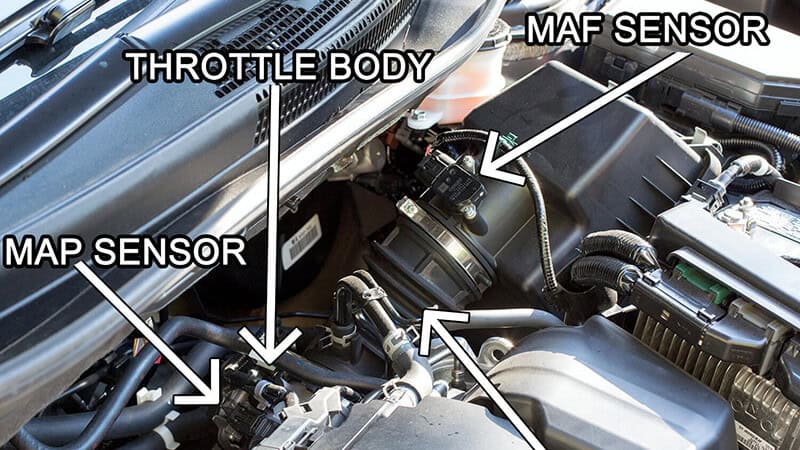
What Is a Mass Air Flow (MAF) Sensor & How It Works
The MAF sensor measures air entering the engine so the computer knows how much fuel to inject. This is simple but crucial for performance.
In most modern vehicles, the MAF sensor is mounted in the air intake tube, usually right after the air filter box and before the throttle body. Every bit of air the engine breathes has to pass through this sensor first.
How the MAF Sensor Works
Most cars on U.S. roads use one of two types of MAF sensors:
- Hot-wire MAF sensor (most common)
- Hot-film MAF sensor
Both work the same way. Inside the sensor is a thin heated element. When air flows over it, the element cools. The engine computer measures the current required to keep the element at the correct temperature. More air means more cooling and a higher current requirement.
From that data, the ECU calculates:
- How much fuel to inject
- When to adjust ignition timing
- How to maintain the correct air-fuel ratio
When the MAF sensor is clean and accurate, the engine runs smoothly, accelerates properly, and gets the fuel economy it was designed for.
Why Dirt Causes Problems
The sensor element is delicate. Dust, oil, or residue can coat it, leading to inaccurate airflow readings.
Instead of receiving real airflow data, the ECU receives false data. That leads to:
- Too much fuel or not enough fuel
- Rough idle
- Hesitation when you hit the gas
- Poor fuel mileage
- Random stalling or surging
A dirty MAF sensor can cause a healthy engine to run poorly.
Quick Note on Symptoms
In a previous article, we discussed in detail the common symptoms of a dirty or failing mass airflow (MAF) sensor, including drivability issues, fuel economy problems, and check engine light concerns. To avoid repetition, this guide will not re-list those symptoms again.
All MAF-related symptoms are caused by inaccurate airflow data, affecting fuel delivery, ignition timing, and performance.
This article focuses on why MAF sensors get dirty and how to clean them, not on symptom diagnosis.
What Causes a Mass Air Flow Sensor to Get Dirty
Mass airflow sensors don’t fail randomly—they get contaminated over time due to issues in the intake system or poor maintenance. Understanding the causes helps prevent repeat problems after cleaning.
One of the most common causes is dirt and fine dust bypassing the air filter. A low-quality air filter, a damaged filter housing, or improper installation allows contaminants to pass through and coat the MAF sensing element.
Another frequent cause is over-oiled aftermarket air filters. Excess filter oil can get pulled into the intake stream and stick to the hot wire or film, insulating it and throwing off airflow readings. This is a very common issue seen in daily-driven vehicles.
The PCV system routes crankcase oil vapors into the intake tract for emissions control. Over time, these vapors can deposit microscopic oil films on the MAF sensing element, especially in higher-mileage engines, gradually distorting readings and leading to drift in fuel calculations.
Driving in dusty or off-road conditions causes more contamination than driving on clean highways.
Lastly, neglected air filter maintenance accelerates the problem. A clogged or overdue air filter restricts airflow, increasing debris concentration in the intake and shortening the MAF sensor’s service life.
Tools & Supplies Needed to Clean a Mass Air Flow Sensor
Cleaning a mass airflow sensor doesn’t require a full toolbox, but using the right supplies is critical. From a mechanic’s perspective, most MAF sensors get damaged not during removal, but during cleaning with the wrong products.
Here’s what you actually need:
Use only a dedicated MAF sensor cleaner. Other cleaners can damage the sensor.
You’ll also need basic hand tools, usually a screwdriver, Torx bit, or small socket, depending on the vehicle. Many MAF sensors are secured with tamper-resistant Torx screws, so having the correct bit matters.
Nitrile gloves are recommended to prevent hand oils from contaminating the sensor. Though not required, they help keep the process clean.
A clean, well-lit area helps you avoid damaging the sensor.
What you should not use:
- Compressed air
- Brushes or cloths
- Cotton swabs
- Any cleaner not labeled for MAF sensors.
Using the right supplies lets you clean and reinstall the sensor safely.
Step-by-Step – How to Clean a Mass Air Flow Sensor (Proper Method)
Cleaning a MAF sensor is simple, but precision is crucial. Follow these steps to avoid damage.
Step 1: Turn the engine off and let it cool:
Make sure the engine is off and cool. Heat can damage the sensor or cause injury.
Step 2: Locate the MAF sensor
Usually found in the air intake tube, between the air filter and throttle body, secured by two screws.
Step 3: Disconnect the electrical connector
Press the tab and gently unplug the connector. Only pull the connector housing, never the wires.
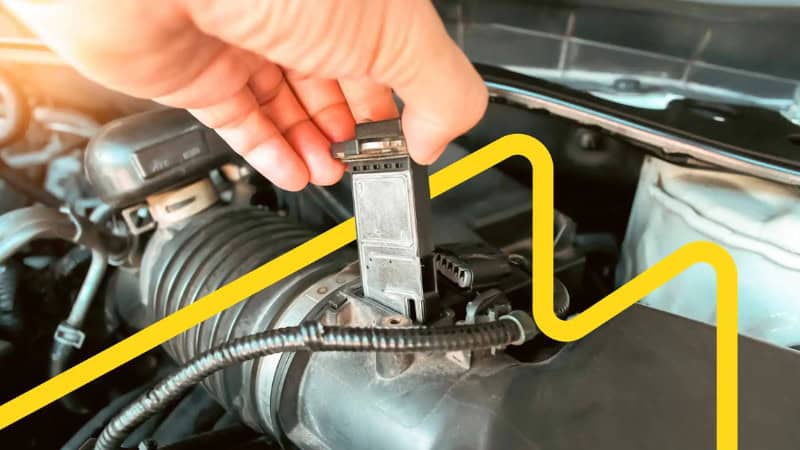
Step 4: Remove the MAF sensor carefully
Remove screws with the correct tool, then lift the sensor straight out. Do not touch the sensing element inside the housing.
Step 5: Spray the MAF cleaner
Hold the sensor by the housing and spray cleaner onto the sensing element and nearby surfaces.
- Use short bursts
- Maintain a safe distance.
- Do not scrub or wipe
Let the cleaner naturally dissolve dirt and residue.
Step 6: Allow the sensor to air-dry completely
Let the sensor air-dry for 10–15 minutes. Don’t use air or heat to speed up drying.
Step 7: Reinstall the sensor
Once dry, reinstall the sensor in the same orientation and tighten the screws just enough.
Reconnect the electrical connector and ensure everything is secure. Reconnect the battery if needed.
After cleaning, your car may improve instantly or after a short drive cycle.
Common Mistakes That Can Damage a Mass Air Flow Sensor
Most MAF sensor damage is due to cleaning mistakes, not age. Simple errors are avoidable with care.
The biggest mistake is touching the sensing element. The thin wire or film in the MAF sensor is fragile; even light contact can break it or alter calibration.
Using non-MAF cleaners can strip coatings or leave residue, causing faults.
Compressed air can break the wire or push debris inside.
Some people try to wipe the sensor, but this often causes damage. MAF sensors should be cleaned only with a spray—never touched.
Moisture inside the sensor causes faults or check engine lights.
Lastly, ignoring intake system issues—such as cracked hoses, vacuum leaks, or over-oiled air filters—means the sensor will quickly get dirty again, even after proper cleaning.
Avoiding these mistakes ensures the cleaning process actually helps, rather than turning a simple maintenance job into an expensive replacement.
Should You Reset the ECU After Cleaning a MAF Sensor?
In most cases, resetting the ECU after cleaning a mass airflow sensor is not mandatory, but it can be beneficial depending on how long the sensor was dirty and how far the fuel trims have drifted.
When a MAF sensor is contaminated, the ECU compensates by adjusting short-term and long-term fuel trims. Over time, those learned values may remain even after the sensor is cleaned. Resetting the ECU clears those adaptations and allows the system to relearn airflow data from a clean sensor.
There are two common ways to reset the ECU:
- Battery disconnect method: Disconnect the negative battery terminal for 10–15 minutes. This clears adaptive memory on many vehicles, though some newer models retain memory longer.
- Scan tool reset: Using a scan tool to clear fuel trims or adaptive values is the preferred and more precise method, especially on modern vehicles.
It’s important to note that after a reset, the engine may idle slightly rough or shift differently during the first few drive cycles. This is normal while the ECU relearns airflow, idle control, and fuel delivery.
If no check engine light is present and the vehicle drives normally after cleaning, an ECU reset is often unnecessary. However, if drivability issues persist or fuel trims are heavily skewed, a reset can speed up recovery.
How Often Should You Clean a Mass Air Flow Sensor?
There’s no fixed service interval for cleaning a mass air flow sensor, but from a maintenance standpoint, cleaning should be condition-based, not mileage-based. A properly functioning intake system can keep a MAF sensor clean for a long time, whereas poor maintenance can quickly contaminate it.
For most daily-driven vehicles under normal conditions, cleaning every 30,000 to 50,000 miles is a reasonable preventive range. This is especially true if the vehicle operates in dusty environments or sees a lot of stop-and-go driving.
Vehicles equipped with aftermarket oiled air filters often require more frequent cleaning. Even a small amount of excess oil can coat the sensing element over time, affecting airflow readings.
High-mileage engines may also need more frequent attention. As engines age, increased oil vapor from the PCV system can accelerate MAF contamination.
It’s important to understand that repeated cleaning in short intervals usually indicates an underlying issue, such as:
- Intake leaks
- Over-oiled air filters
- Poor air filter quality
- Excessive crankcase blow-by
In those cases, addressing the root cause is more important than repeatedly cleaning the sensor.
Cleaning vs Replacing a Mass Air Flow Sensor
Cleaning a mass air flow sensor is often the first and smartest step, but it’s not always the final solution. From a diagnostic perspective, the decision to clean or replace comes down to sensor condition, mileage, and data accuracy.
Cleaning makes sense when the sensor is physically intact, and contamination is the primary issue. If the sensing element is unbroken and the connector and wiring are in good shape, cleaning can restore accurate airflow readings and normal engine operation.
A replacement is necessary when the sensor is damaged, either electrically or physically. If the hot wire or film is broken, burned, or shows signs of internal failure, no amount of cleaning will fix it. Persistent drivability issues and recurring fault codes after cleaning are strong indicators that replacement is required.
High-mileage vehicles may also reach a point where replacement is more reliable. Over time, heat cycles and vibration can degrade sensor accuracy, even if the sensor appears clean.
Another factor is scan tool data. If airflow readings remain out of range, fuel trims stay excessive, or the engine runs better with the MAF unplugged, replacement is often justified.
When replacing a MAF sensor, OEM or high-quality aftermarket units are strongly recommended. Cheap, low-quality sensors frequently cause new drivability issues and false fault codes.
What Problems Can (and Can’t) Be Fixed by Cleaning a MAF Sensor
Cleaning a mass airflow sensor can solve many drivability complaints—but it’s important to set realistic expectations. In the shop, I always explain to customers what cleaning can fix and where its limits are.
Problems Cleaning Often Fix
When contamination is the main issue, cleaning the MAF sensor can:
- Restore smooth idle
- Improve throttle response
- Reduce hesitation or stumbling.
- Improve fuel economy
- Correct minor lean or rich conditions
- Clear airflow-related fault codes after a drive cycle
In many cases, drivers notice improvement immediately after cleaning, especially if the sensor was heavily contaminated.
Problems Cleaning Will NOT Fix
- Cleaning will not solve issues caused by:
- A failed or broken MAF sensing element
- Wiring or connector problems
- Intake air leaks or vacuum leaks
- Fuel delivery issues (fuel pump, injectors, pressure)
- Ignition problems (spark plugs, coils)
- Engine mechanical problems
If symptoms remain after cleaning and proper ECU relearn, further diagnosis is required. At that point, scan tool data, wiring checks, and intake inspections become more important than additional cleaning.
Professional Perspective
From a mechanic’s standpoint, MAF sensor cleaning is a low-risk, high-reward first step, but it should never replace proper diagnosis. When used correctly, it helps rule out contamination before moving on to more expensive repairs.
Professional Tips to Extend Mass Air Flow Sensor Life
Keeping a mass air flow sensor clean isn’t difficult, but it does require proper intake system maintenance. Most premature MAF issues I see are preventable with a few simple habits.
Start with the air filter. Always use a quality air filter and replace it on schedule. A damaged, poorly seated, or low-quality filter allows fine debris to pass straight into the intake and onto the MAF sensor.
If you use an aftermarket oiled air filter, apply oil sparingly and evenly. Over-oiling is one of the most common causes of repeated MAF contamination. If the vehicle is a daily driver, a dry-style filter is often the safer choice.
Regularly inspect the intake ducting between the air filter box and throttle body. Cracks, loose clamps, or collapsed hoses allow unmetered air to enter the engine, affecting airflow readings and accelerating sensor contamination.
Maintaining the PCV system is also important. Excessive oil vapor increases residue buildup on the sensor. Replacing a stuck or restricted PCV valve can significantly slow MAF contamination.
Lastly, avoid unnecessary cleaning. Over-cleaning can be just as harmful as neglect, especially if the sensor is handled too often. Clean only when symptoms or data indicate it’s needed.
Final Thoughts – Is Cleaning a Mass Air Flow Sensor Worth It?
From a practical mechanic’s standpoint, cleaning a mass air flow sensor is absolutely worth doing—as long as it’s done correctly and for the right reasons. It’s inexpensive, quick, and often restores drivability issues that feel far more serious than they actually are.
If the sensor is simply contaminated and not electrically damaged, cleaning can bring back smooth idle, better throttle response, and improved fuel economy with minimal effort. For DIYers, it’s one of the safest first steps before replacing parts.
That said, cleaning is not a cure-all. Persistent symptoms after proper cleaning and ECU relearn point to deeper issues such as intake leaks, wiring faults, or sensor failure. In those cases, professional diagnosis or sensor replacement becomes necessary.
The key takeaway is this: use MAF sensor cleaning as a smart diagnostic and maintenance step, not a guessing tool. Done properly, it saves money, prevents unnecessary parts replacement, and keeps the engine running the way it should.
FAQs
Can I clean a MAF sensor without removing it?
It’s not recommended. Spraying the sensor while it is installed can push dirt deeper into the intake and fail to properly clean the sensing element.
What cleaner should I use for a MAF sensor?
Only use a dedicated mass air flow sensor cleaner. Other cleaners can permanently damage the sensor.
How long does it take to clean a MAF sensor?
The cleaning itself takes about 5 minutes, but you should allow 10–15 minutes for complete air-drying before reinstalling.
Will cleaning a MAF sensor turn off the check engine light?
If the light is caused by contamination, it may turn off after a few drive cycles or after clearing codes.
How often should a MAF sensor be cleaned?
Typically, every 30,000–50,000 miles, or sooner if the vehicle operates in dusty conditions or uses an oiled air filter.
